A few recent books on popular music you might be intrested in

by sonicscape

By no means I read these all, but I jotted down the titles of these books (actually put them in my Amazon wishlist for later). They are not necessarily “academic” books.

governing

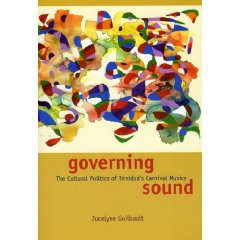
Governing sound: The cultural politics of Trinidad’s carnival musics
by Jocelyne Gilbault (University of Chicago Press, 2007)

I think she is a well-known ethnomusicologist especially to those who are intrested in Caribbean music and cultural identity issues around popular music. She is known as an expert on Zouk and now this work is on Trinidad’s Calypso and Soca (Soul + Calypso). The title gives a hint of Foucault, I guess.

heavymetal

Heavy metal Islam: Rock, resistance, and the struggle for the soul of Islam
by Mark Levine (Three Rivers Press, 2008)

I had no idea about the author, but I read a review about this book published in NYT this weekend. The fact that the author arduously observed and interviewed local heavy metal, punk and reggae musicians in Islam world makes this work itself worth reading. This book might be interesting to those whose issues are (Islamic) youth culture, identity and politics.

pirate

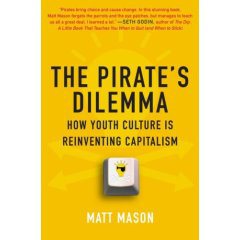
The pirate’s dilemma: How youth culture is reinventing capitalism
by Matt Mason (Free Press, 2008)

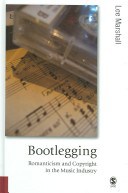
The title tells everything: celebration of DIY, open source music? I guess it might be a technologically-centered and naively-too-much-optimistic work. In fact, a review article in Guardian interests me in this book written by a British journalist. Worth checking out if you are intrested in digital technologies, youth culture, digital culture, digital copyright and piracy issues. It hit upon me that it might be better it is accompanied by an academic work — Bootlegging: Romanticism and copyright in the music industry by Lee Marshall (Sage, 2005).

bootlegging

Happy reading!

History of Korean popular music through films (1): Radio Days and Kim Hae-song

by homey81

radio_days-poster

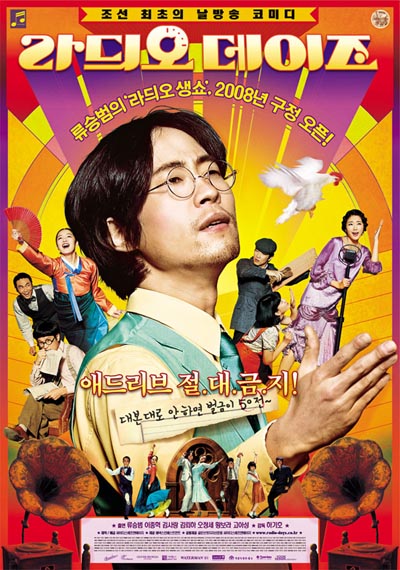
In last April, a film “Radio Days” were released.  The film was  comedy around the production of the first radio drama in Korea in the 1930s.  There are other films that dealt with popular culture in the 1930s like “Modern Boy” and “Once upon a Time in Korea.” It has been a sort of “trend,” but the commercially so-s0.

Anyway my focus is not the film itself but the soundtrack of the film, The music director of the film, Sung Kiwan is the leader of the respected indie band The 3rd Line Butterfly (some of here saw the band play in July 2005 after Inter-Asia cultural studies conference). Recently he has been obsessed with Kim Hae-song: 金海松: 1913-1950) who was one of the important figures in Korean popular music and one of the pioneers of “jazz” and “musical” in the 1940s.

hae-song-kim-and-his-band-members

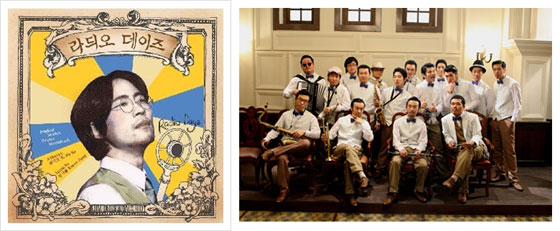
Kim Hae-song (left) and his band members (right). In the latter, the third from the right is Kim and the first from the left is Lee Nan-young who was Kim’s wife and was “the voice of colonial Korea”). Unfortunately I could not found out the date and year when the photo was taken.

In the film, Kim’s songs were used frequently. And the song “Youth Class (Cheongchun Kye-geup)” was a sort of theme song of  the film. The date of original recording is around 1938 or 1939 and the SP record was released by Columbia record (Korean branch of Japanese record company and on eof the biggest one at that time). Although Kim Hae-song concentrated on composing, arranging and conducting after 1940s, he recorded some songs in the 1930s. In my view, he can be compared to Japanese songwriter Hattori Ryoichi (服部良一) or Chinese songwriter Chen Gexin (陳歌辛). Sadly he died during Korean War (around 1951?) .

radio_days_jodk_big_band

In soundtrack album, there are two versions of “Youth class.” The one is original recording and the other is cover version JODK big band which was formed by the fil soundtrack by the members of different indie bands (trivia: JODK was a call-sign of Kyongsong (Seoul) Radio broadcasting company. JOAK was for Tokyo, JOBK was for Osaka and JOCK was for Nagoya. It is said that JOEK was reserved for Taipei).

You can hear the song in the links below.

Youth Class by Kim Hae-song (recorded around 1938?)

Youth Class by JODK Big Band (recorded in 2008) 

The lyrics were written by Cho Myung-am (趙鳴岩) who used to have been “modernist poet” and so-called “converted left-wing intellectuals” after 1930s. I hope I can tell his second life in North Korea after War later. Now I will just translate the lyrics into English. It is hedonistic ad “decadent” with “exotic” words  from French, Russian, German… It seems that Korean (male) intellectuals desired not only liberation but also consumption. 

 Youth Class

Lyrics by Cho Myung-am
Music by Kim Hae-song

Let’s sing songs, soneta of love.
Let’s sing a song until this night is gone
Oh, beautiful amoreu (amour). Oh, daririr-daririr-daradda.
Let’s dring Woka (vodka) and sing songs

Let’s dance, tap dance of love
Let’s dance until this night is gone
Oh, pretty girl. Oh, daririr-daririr-daradda.
Let’s drink shampang (champagne) and let’s dance

Let’s dance and sing. This is paresu (palace) here.
We are Eroika, the brave of the shadow.
Oh, tender devil. Oh, daririr-daririr-daradda.
Let’s drink shampang (champagne) and let’s dance and sing!

Lstly, the trailer of the film is here: http://www.youtube.com/watch?v=L4vIoK_rDzk&feature=related

(HJ)


Inter-Asia Popular Music Studies Conference 2008 in Osaka

Inter-Asia Popular Music Studies Conference 2008 in Osaka: Call For Papers

Date: 26 (Sat)-27 (Sun) July 2008
Venue: Osaka City University, Takahara Hall
(3-3-138, Sugimoto-cho, Sumiyoshi-ku, Osaka-shi, JAPAN)
http://www.osaka-cu.ac.jp/english/info/access.html

Organized by:
Inter-Asia Popular Music Studies Group (https://interasiapop.org/)
and
Urban Culture Research Centre (UCRC), Osaka City University
(http://www.lit.osaka-cu.ac.jp/UCRC/index-e.html)

Conference theme: Globalizing Music Industry in Asia

Rationale:
We are pleased to announce the first Inter-Asia Popular Music Conference in Osaka in collaboration with Osaka City University, Urban Culture Research Center (UCRC) in July 2008.

Over the last two decades, the study of popular music has been dramatically developed in the interdisciplinary fields from musicology, sociology, literature, history, education, anthropology, to media & communications and cultural studies since the establishment of the International Association for Study of Popular Music (IASPM) in 1981. A similar trend has also been observed in the Asian continent where more and more scholars are involved in the critical studies of popular music.

Today, however, we face two major problems to be considered generally among scholars of non-Western(Asian) popular music cultures: Firstly, while it has been well established academically as an distinctive field of study in Western campuses, research efforts on popular music in the Asian contexts remains largely scattered, limited without. There are currently no institutions devoted to popular music studies within Asian universities, and the more sustained interactions of scholars in this field in the region have also been hampered by language barriers. Secondly, in spite of its more globally diffused patterns of distribution, appropriation and consumption, scholarly accounts on Asian popular music has been predominantly centered within contemporary national boundaries Such existing paradigms would have to be revised in light of the recognition of the socio-cultural fluidity arising from developments in communication technologies as well as more intensified rates of human migration.

As part of our preliminary efforts to address theses issues these problems, we launched an online based, transnational research portal, Inter-Asia Popular Music Studies Group in 2007, and have also started discussions among about 40 scholars not only in Asia but also in Europe and the United States.

In the first international conference has a main theme entitled ‘Globalizing Music Industry in Asia’, by which we would like to focus on the recent situation and historical trajectory of popular music genres in Asia like rock, pop music to hip hop and dance music which have been heavily influenced by globalization of music industry, in particular, the restructuring of global capital, the radical change of distribution network including media and internet and the transformation of fan’s practices.

Possible session themes:
Music, internet and piracy (Copyright)
Beatles in Asia
Hip hop in Asia
Transnational flow and consumption of popular music
Border-crossing Pop stars and their mediation of Asian modernities
Recycling of old Asian pop in film/drama
Asians in global experimental music scenes
Transformation of creative labour in music industry
Inter-Asian collaboration/adaptation of popular music
Music consumption by/of trans-Asian migrants
iPod and mobile music
Music for Practical uses (film, drama, game soundtrack)
Asian diasporic music outside Asia

*Any other suggestions will be welcomed.

Schedule:
30 May The first deadline of application
26-27 July Conference

Call for papers
The organizers of Inter-Asia Popular Music Studies Conference 2008 in Osaka would like to invite paper presenters to send their abstracts (not more than 250 words) before 31 May, 2008 to; IAPMS2008@yahoo.co.jp

If you have any inquiries, please be free ask Yoshitaka Mori:
IAPMS2008@yahoo.co.jp

Registration Fees:
Faculty member and staff: 3000 JPY (=US$ 30)
Student:2000 JPY (=US$20)

Inter-Asia Popular Music Studies Conference 2008 in Osaka Organizing
Committee:

Shin NAKAGAWA,
Professor and Director of Urban Culture Research Center Osaka Ciity
University, Japan

Hyunjoon SHIN, Professor, Sungkonghoe University, Korea

Yoshitaka MORI, Associate Professor, Tokyo University of the Arts

Anthony FUNG, Associate Professor, Chinese University, Hong Kong

Kyoko KOIZUMI, Associate Professor, Aichi University of Education, Japan

Tunghung Ho, Associate Professor, Fu-jen University, Taiwan

Satoshi MASUDA, Associate Professor, Osaka City University, Japan

Kai Khun LIEW, Postdoctoral Fellow, National University of Singapore,
Singapore

Jung-Yup LEE, University of Massachusetts Amherst, USA/Korea
by homey81

mike_park_0804191

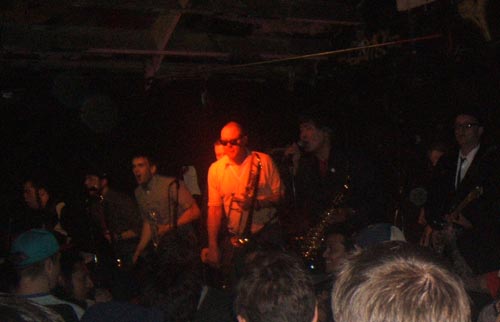
On the last Saturday, 19 April, I happened to be in Berkeley (exactly Albany) during stopping over my trip between Hawaii and the Netherlands. On that day, there was a concert in 924 Gilman Street (it is both the address and the name of the club). I heard the news of concert tour by Mike Park, who was one of the pioneers of “The Third Wave of ska (or skapunk)” in Bay Area, forming and disbanding of numerous bands including Skankin’ Pickle, the Chinkees and Bruce Lee Band. However, since a couple of years ago, he has become a solo singer-songwriter who sings with only the accompaniment of his acoustic guitar alone. But the show on that day was different.

The show was organized for the memorial/tribute of the late Lynette Knackstedt, a (female) guitar player in Skankin’ Pickle who died on 7 December last year.  The concert was for donating for her and her family and organized by Mike himself. [Accoding to Mike Park, other bands were the Boars(60’s garage punk featuring Lars from Pickle on Organ and vocals), The Bar Feeders(SF MISSION punks, good friends of Lynette), and Lucifer’s Strip Club Band(Lynette’s last band, playing burlesque type jazz, lounge, swing music)].

Although I (and Jaeyoung) missed Mike’s solo performance because of stupid reason, we could enjoy the performance of Skanaking Pickle’s songs like “I am in Love with a Girl named Spike,” and “I missed the Bus.” It has been long since Mike Park played with full band set and he himself seems to be inspired, swithching singing songs and blowing saxophone. I did not know that ska is so energizing and the sound was quite different from that I heard through CDs ot mp3s.

Although I could not record the show, you can enjoy Skankin’ Pickle’s live performance clip. Alas, already 15 years ago… : http://www.youtube.com/watch?v=p7Z8jCWB5pM.

Joon

News from the Netherlands: Yiufai’s CD and STEIM

by homey81

Although it has already been more than one month since I began to stay in the Netherlands, nothing interesting happened. So I post what happened one month ago.

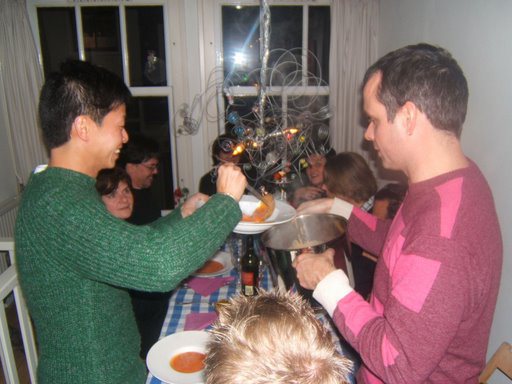
On 23 January, I visited Yiufai’s beautiful 3 storey house in Amsterdam where a part was held. There I had good dinner whuch Yiufai cooked. Please see the picture of Yiufai and Jerone, when they distibute the dishes.

yiufai_and_jerone

I could also see Yiufai’s CD, not the one he has bought and owns, but the one titled his name. It is “CD book” which contains 18 songs and written lyrics penned by him. The title of the CD is “Eighteen Changes” (as far as I know). You can buy it online at http://global.yesasia.com/en/PrdDept.aspx/code-c/section-music/pid-1005167818/

chow_yiufai-18_changes

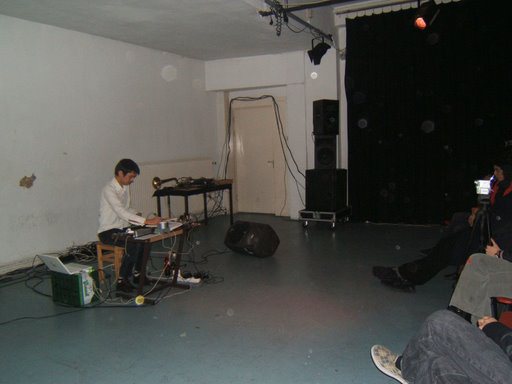
On the next day, 24 January, there was an experimental music concert at STEIM, which is, in their words, Center for research & development of instruments & tools for performers in the electronic performance arts. Laboratory, workshop, international meeting place, artist hotel, production office, live electroacoustic music, DJ’s, VJ’s, theater and installation makers, video artists and nomad studio. [http://www.steim.nl]

byungjun_steim

There my friend Byungjun, who now studies in Royal Music Academy in Hague but used be one of the leading figure in Korean underground indie-electronica-experimental music scene. You can hear some music samples about his recent works at http://byungjun.pe.kr/. For those who are interested Korean indie music in the late 1990s and the early 2000s. Please watch the video by Pipi Longstocking produced in 1997.

pipilongstocking1997.jpg

Hope you enjoy…

HJ (a.k.a. Homey)

The 1st Inter-Asia Popular Music Studies Group Conference in OSAKA, 2008

by mouri

Dear all,We  are  now pleased to announce that we will organize the 1st Inter-Asia Popular Music Studies Group Conference on 26th & 27th July 2008 in Osaka, Japan,  jointly with Urban Culture Research Center (UCRC), Osaka City University. Please write down the date above in your diary.  As it will be a call-for-paper conference, please encourage your colleagues and friends to participate, too. The detail will be circulated soon. Wait for a further announcement.Yoshitaka Mouri, Tokyo National University of Fine Arts and Music

Kinglychee–Hong Kong Indie Hardcore Rock Band: Free CD download

by angel_lin

Hi All,

Hong Kong’s reputable indie hardcore rock band, Kinglychee (literally “King of Lychees”; lychee is a tropical fruit :)) has just released its new CD, freedownload of all songs and lyrics from the following webiste: http://www.kinglychee.com/ Kinglychee consists of mainly South East Asian artists in HK… they do their songs mainly in English; a very good indie hardcore band :)!  Enjoy! cheers, angel

A Journey Back to the Ancestral Homeland: Kite Operations’ Korea Tour Diary

by plateaux

Following is the intro of the article I posted at koreanpop.org. Click here for the full text.

(from left to right) Jie, Joe, Sung, Dave

Kite Operations: (from left to right) Jie, Joe, Sung, Dave

Kite Operations is an independent rock band based in the New York City. All four members are of Korean-American origin, sprung up from the Korean immigrant community in New York. Joseph (Joe) Kim (g, v) and David (Dave) Yang (g, v) were born in the states, while Jie Whoon Kang (b) and Sung Shin (d) belong to the ‘1.5 generation’ who came from Korea at an early age. Kite Operations is about five years old, but the actual history is longer than that as Joe and Dave formed a band named Theselah along with two other – now departed – members way back in 1994.

Theselah recorded three albums between 1999 and 2002, all under their own label, K.O.A. records. After recruiting Jie and Sung, they released two EPs under the new band name, Kite Operations, in 2003. They embarked on their full-fledged flying mission with the first Kite Operations LP ‘Dandelion Day’ (2005), followed by ‘Heart Attacks, Back to Back’ (2007). Over the past few years, Kite Operations has frequently played live gigs around the New York area, toured the Midwest and the West Coast areas, and participated in Asian American rock festivals. For more information, as well as the music samples, visit their website.

Their ‘ethnic connection’ to Korea owes a great deal to Sung, the youngest member of the band who had been immersed in Korean indie music before coming to the states. His reaching out toward the Korean indie music community started bearing fruit as the Kite Operations LPs were licensed in Korea. Finally, the band earned an invitation to play at the 2007 Korean Festival in Seoul along with other overseas ethnic Korean musicians, including the Chinese rock legend Cui Jian. Kite Operations took full advantage of the opportunity, booking a mini-tour of three Korean clubs before the festival gigs.

When I heard the news that they were going to Korea, I asked them to write a tour diary for online publication. In response, they sent me Joe’s diary accompanied with a bunch of photographs and audio-visual files. Many thanks to Kite Operations for putting them together and sharing with us, and I hope readers to enjoy their unique experiences as much as I did.

Rockin’ the Boat in Thailand

by viriya

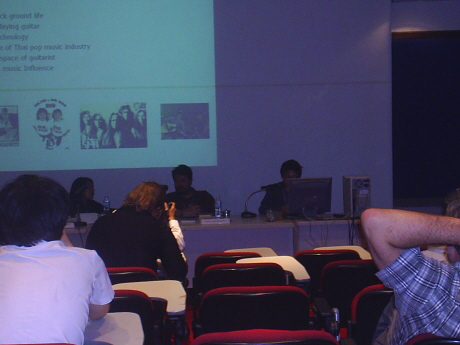
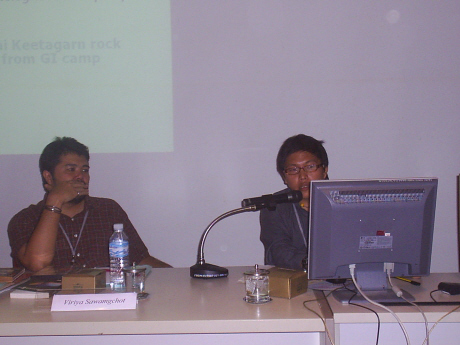
Hello all, it is local news of members from Thailand. On January 11th, 2008 at 10th international conference on Thai Studies, Thammasat University, Bangkok Aj. Ubonrat was a chair of “Thai rock music and its culture” panel which was organized by me. The theme of panel is to discuss of Thai rock music and its culture since the 1980s within the perspective of class, gender and generation. We have 4 panelists (including me) in the panel; (1) “Which Boat is Rockin? : Rock Music and Mass Politics in Thailand” by Viriya Sawangchot, Wathansala Centre for Cultural Studies. (2) “Not Anyone Can Play My Guitar: The Study of Thai Guitar Heroes since the 1980s” By Kachachai Wichaidit, Music 499 Academy (3) “Chiang Mai ‘Indie’ Music: Local Space and Its Changing Mind” by Viparat Panritdam, Chiang Mai University (4) “I Wanna Shout but Who Is Listening?: ‘Thai Female Rocka’ and ‘His’ World” .by Siriporn Somboonburana, Walailak University.
Exactly, all panelists never attend this conference before but Aj Ubonrat mentioned that it was the first time of pop & rock music panel in three decades of Thai Studies conference. Anyway, on October 27th, 2007, we had a prior one called “For Those About to Rock” were co-organized by Wathanasala and Music 499 Academy. In this informal meeting, we had a forum discussed by cultural researchers, music business men and professional musicians on rock music scene in Thailand since the 1970s and also had a live performing at the end of the day. Aj. Ubonrat was there and had a speech on opening as well.

222

M4034S-4211

M4034S-4211