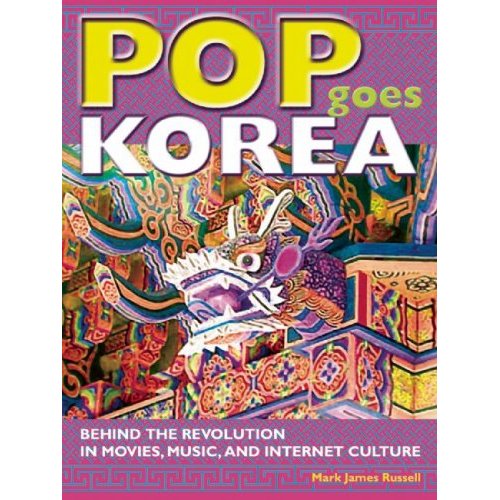
Korea Goes Pop by Mark Russell

Pop Goes Korea_cover_small_

A book about Korean pop culture by Mark Russel; Pop Goes Korea : Behind the Revolution in Movies, Music, and Internet Culture (Stone Bridge Press (January 1, 2009).

Contents

Introduction

Korean History: A Primer / Modern Pop Culture / A Note on Korean Language / Acknowledgement

1. The Deal
Saving the Cinema / CJ Entertainment / A Per-History / The Foundation / Making Movies / The Rise of the Multiplex

2. The Blockbuster
Getting Started / First Steps / A Commercial Revolution / Just a Fluke? / Building a Bigger / Blockbuster / A Culture of Hits

3. The Film Festival
Preceding PIFF / Finding a Patron / The First PIFF / From Film Fans to Film Making

4. The Actor and the TV drama
French, Religion, and Other Whims / Making Airwaves-TV Begins in Korea / Trying Out / Out of the Flying Pam / Stepping Up

5. The Music Mogul
Schoolhouse Rock / Living in America / Prelude to a Revolution / The Rise of SM Entertainment

6. The Music Thieve
Cyber Simmering / Let the Sea Make a Noise / Free as a Bird / Going Legit

7. Thin Black Line
Early Cartoons / The Modern Comic Book Era / The Animation Divide / Comic in Internet Age / Artistic License

Conclusion
Waving Goodbye / Pop Goes the World

Index

——————————————

Although the book is not academic in a narrow sense and the parts about pop music is about two or so, you can get rich information about what is going on Korean cultural industries. A review of the book by the publisher is here, where an interesting remarkis found: “It avoids two dangers:  it does not follow tabloid rumor mills, and it also avoids the impenetrable jargon that has come to dominate ‘culture studies.’  This is a book one can read with great interest.”

About the author’s blog, http://www.koreapopwars.com/.

(Joon/Sjon)
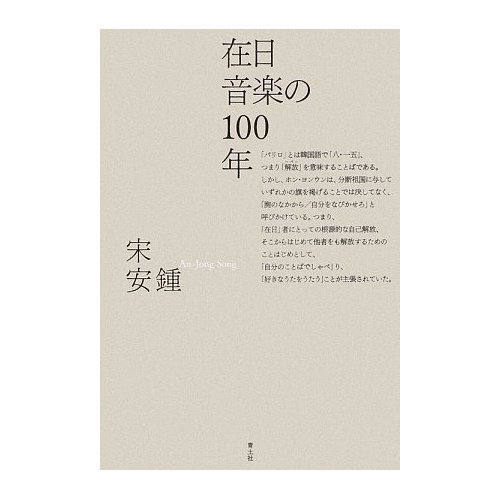
 

A Hundred years of Zainichi (Korean minorities in Japan) Music

by homey81

41eealmqrwl__ss500_1

A book about the history of (popular) music by Zainichi – Korean minorities in Japan – was published. The title is A Hundred years of Zainichi Music (Seidosha, 2009.2). The author is An-jong Song  (Song An-jong 宋 安鍾 in East Asian style) who has been teaching at Kanazawa University and one of Korean minorities in Japan himself. Below is the translation of the table of content.

Contents

Chapter 1 Searching for ‘Zainichi music’
1. What Zainichi music is
2. Who are Korean Residents in Japan or Zainichi, What is Zainichi music
3. Music(s) called Zainichi as multi-cultural public sphere

Chapter 2 Swining Arirang. Women in-between singing and dancing revolt
1. Could you hear? The song of Arirang
2. Bae Gu-ja, became Shokyokusai’s the first student (1910’s – 1926)
3. Quit the Tenkatsuza and retired from entertainment scene in mainland Japan (1926-27)
4. Bae Gu-ja, traveling with Swinging Arirang (1928-1937)
5. The Beginning of travel without Ending (1937-2003)

Chapter 3 The Age of Hero who were covered all over with wounds: Popular music in Korea and postwar Japan and
1. The Genelogy of Koreans in Japan (Putekyan)
2. The Childhood (1927-43)
3. The Days at Kyosei(Seoul) Dentist School (1943-49)
4. Illegal migration to Japan and the activities in Japanese entertainment scene (1950-60)
5. Going back home and the return to Korean entertainment scene (1960-67)
6. The glory and fall in Korean entertainment scene and the death (1967-95)
7. Are the songs of the refugees from North Korea pulsating in Korean-Japanese music?

Chapter 4 The genealogy of the emerging ‘sons of darkness’: After ‘liberation’ / the second generation who were born after the war and Zainichi music
1. Stars of nisei (the second generation) musicians
2. What should be read from the careers
3. The second generation explored the new fertile field of Zainichi music
4. Cut&mix – the present seen from the songs by the second generation followed one after another

Chapter 5 Where are Korean-Japanese music going to? – Beyond one hundred years
1. New generation musicians emerging one after another
2. The period of ‘diversification’ of identity and ‘Zainichi music’
3. Where is Zainichi music going to?

Note
Reference, Websites, Sounds
Acknowledgement – Postscripts

Below is the table of contents in Japanese original. It would be appreciated if anybody let me know the wrong and incorrect translation.

【目次】

第Ⅰ章 「在日音楽」 を模索して
1 「在日音楽」 ということば
2 「在日韓国・朝鮮人」、あるいは 「在日」 とは誰か、その音楽とはなにか?
3 多文化公共圏としての 「在日している (諸) 音楽」

第Ⅱ章 スウィングする 「アリラン」、うたい舞い叛逆するはざまの女性
―― 「在日音楽」 の起源を問う
1 聴こえるだろうか? 「アリラン」 のうたは
2 裵龜子、初代松旭斎天勝に弟子入りする(一九一〇年代~一九二六年)
3 天勝座からの脱退と 「内地」 芸能界からの引退(一九二六~二七年)
4 裵龜子、スウィングする 「アリラン」 と旅する(一九二八~三七年)
5 終わりなき旅のはじまり(一九三七~二〇〇三年)
6 裵龜子と 「アリランの唄と踊り」、「在日音楽」 の起源と未来

第Ⅲ章 満身創痍の 「英雄」 たちの時代
―― 韓国・戦後日本の大衆音楽と吉屋潤、そして 「在日音楽」
1 「プテキャン」 の系譜
2 幼少時代(一九二七~四三年)
3 京城歯専時代(一九四三~四九年)
4 戦後日本への密航と日本芸能界での活動(一九五〇~六〇年)
5 帰国と韓国演芸界への復帰(一九六〇~六七年)
6 韓国演芸界での栄達と没落、そして死(一九六七~九五年)
7 越南失郷民のうたは 「在日音楽」 のなかで脈打つか?

第Ⅳ章 立ち上がる 「闇の子供たち」 の系譜
―― 「解放」 後/戦後生まれの 「二世」 たちと 「在日音楽」
1 「二世」 ミュージシャンたちの群星
2 経歴から読みとるべきこと
3 「二世」 たちは新たな 「在日音楽」 の沃野を切り拓く
4 「切れて、繋がる」/Cut&Mix――踵を接する 「二世」 たちのうたにみる現在

第Ⅴ章 「在日音楽」 のゆくえ
―― 一〇〇年を越えて
1 続々と登場する新世代のミュージシャンたち
2 アイデンティティの 「多様化」 の時代と 「在日音楽」
3 「在日音楽」 のゆくえ


参考文献・サイト・音源
謝辞――あとがきにかえて


[IIAS workshop] East Asian Popular Music: Small Sounds from Big Places?

by homey81

http://www.iias.nl/?q=east-asian-popular-music-small-sounds-big-places

East Asian Popular Music: Small Sounds from Big Places?

26 november 2008
14:00 – 17:30 hrs

Convenor: Prof. Hyunjoon Shin, (European Chair of Korean Studies, International Institute for Asian Studies, Leiden)

This workshop deals with cultural shifts from the angle of popular music. Four scholars will present papers on East Asian popular music and popular music in East Asia.

They will address questions like: How is local/national identity constructed (or deconstructed) in East Asia through popular music? Do the border-crossing practices of the music industry create “regional” subjectivity and/or identity? How does popular music integrate different parts of local places in East Asia? Where and in what form has East Asian popular music been present outside the region?

Preliminary programme

14:00 – 14:10
Opening Remarks by Bart Barendregt (Leiden University, the Netherlands)

14:10 – 14:50
Hyunjoon Shin (International Institute for Asian Studies, the Netherlands)
SEOUL A GO-GO: Group Sound in the 1970s and Collective Memory

Discussant: Remco Breuker (Leiden University)

14:50 – 15:30
Michael Fuhr (Heidelberg University, Germany)
Globalizing K(yopo)-Rock? Music, aesthetics and Korean migrant ritual in Germany

Discussant:
Birgit Abels (International Institute for Asian Studies, the Netherlands / Ruhr University Bochum, Germany)

15:30 – 15:50
Coffee break

15:50 – 16:30
Yoshitaka Mouri (Tokyo University of the Arts, Japan)
Sound and the City: A Variety of Town-Sounds in Tokyo

Discussant:
Eve Leung (The School of Oriental and African Studies, University of London, UK)

16:30 – 17:10
Jeroen Groenewegen (Leiden University, the Netherlands)
Humour and Parody in Chinese Popular and Rock Music

Discussant:
Yiu Fai Chow (University of Amsterdam, the Netherlands)

17:10 – 17:30
General discussion and conclusion


Venue: KITLV, Room 138 (Conference Room), Reuvenplaats 2, 2311 BE, Leiden

Information and registration
Martina van den Haak
m.van.den.haak@let.leidenuniv.nl
071 5273317


Wed, 26/11/2008 – 14:00

History of Korean popular music through films (3): ‘Go Go 70’ and the Devils (데블스)

A film about 1970s Korean popular music was released on the early October. The title is Go Go 70.

gogo70-poster1

The film was inspired, of course partly, form my book called An Archaelogy of Korean pop music 1960s/1970 (2 volumes) published in 2005. I met the director (Choi Ho 최호) and the producer of the film last year and exchanged the view about the concept of the film. Although I was not involved in film making and still don’t know what the film is about, I thought it lucky that the band (fictional) in the film was based on soul group called the Devils which had existed in the 1970s. You can see teaser and music video clip at youtube: TrailorTeaser and Music Video.

About the recorded music by the “real” band, I would like to share some mp3 files which I extracted from the LP, which is the second full length album released in 1974 (Thanks for the one who borrowed the records).  Hope you are generous about the quality of recorded sound. Many people said that most of the bands recorded one album in one or two days until the mid-1970s in South Korea.

devils_1974

The Devils – Theme from Shaft (inst.)

The Devils – don’t_know, don’t_know (몰라요 몰라)

The Devils – The Song of my Love (님의 노래)

About the books published about 3 years ago, one news paper article is at here . One question to myself: do I have to internationalize these kinds of local knowledges/studies?

P.S.

The review about the film does not seem to be good and one comment by a female film critic was that “does the film want to enlighten decadence?.” Moreover, it is said that there are some controversies going on in South Korea about the “correct representation” of different personalities in the film. Hope I can tell you in detail later. But que sera…

Joon

Digitizing 76rpm SPs

tn-400nip78_polydor_s65-a-b-300x146

I read an interesting article in the Wired blog and wanted to share it with you:

One Man’s Quest to Digitize and Publicize Rare Vinyl

The man named Cliff Bolling have been digitizing hundreds of 78rpm SP records into mp3 forms for the last five years, and still thousands to go. In his archiving website, you can find many interesting soundbites from the early age of electronic reproduction of music. The way different musical reproduction technologies with different epochal significance are meeting as we have seen in the cases of turntable, cassette tape, etc.

If you’re into Japanese music history, his Japanese records page is worth visiting. As I am not an expert, I have no idea how rare these Japanese records are (considering Japanese archiving culture, they might not be). But it is cool to have an access to old Japanese records from your laptop. One record with lyrics and dance moves attached looks cool! Another one I like is “Drinking Song” which sounds to me a “traditional” song and performance accompanied by simple shamisen playing.

History of Korean popular music through films (2): “Song of Hope (希望歌)”

by homey81

Let me start with my personal experience in the 1980s. If you don’t like “Marxist days” of East Asian scholars, you can skip the first and second paragraph.

In the early and mid-1980s, when I was a university student in Seoul, lots of students sang this song especially during drinking. The song title was simply “song of hope (heui-mang-ga: 希望歌).” The song delivered the feeling of despair and despair. At that time, for the students who were still thinking that they are the main subjects of the reform (or revolution!) of society but that “the enemy” (in the vocabulary at that time) was too strong to overthrow. So despair and resignation was the normal feeling in everyday life.

I will stop (self-)psychoansis. Although they talked about politics and society, university freshmen were just 18 or 19 year old and could not know what the world is about. So most of them sang songs in crummy pubs for self-consolation, with heavy drinking soju and maggeolli (rice wine). At that time, the only “recorded” version I could listen to was Hahn Daesoo’s recording in 1975 in his official second album. Put it simple, he was “Korean Bob Dylan” anmd you can sense what that means if you hear his voice. I will skip his story and come back to his music later on.

hahn_dae-soo_-_gomushinrubber_shoes1-282x300Heemanga (Song of Hope) – Hahn Dae-soo (1975)

In the 1980s, university students took it for granted the song is one of “orally inherited” Korean folksongs. Looking back, three meter rhythm and pentatonic melody line did not make them (including me) throw doubt about the origin of the song. As you might know, traditional Korean folksong was based on pentatonic melody and 3 meter.

2

After 1990s when students did not sing the song any more, I got to know that the melody of the song came from Japan and that Japanese also adapted British melody to Japanese lyrics. To be more exact, the melody was exported to America (US) and was transformed into a Chiristian hymn title “Garden.” I found out two scores of a song inserted in a paper which one of my Japanese friends kindly shared. I also could discover two version of the song by searching in internet: the one is American hymn version and the other is Japanese instrumental version.

scorewhen_we_arrive_at_home_mashiroki_fuji1-150x150
Garden (American hymn version)
  The Root of White Fuji Mountain

Unfortunately I don’t know much about the detailed information. What I’ve heard is that Japanese version was created for the requiem of the high school students who were drowned in the sea in 1910. The lyricist was a female teacher who worked in the region. The song title was stabilized as “The Root of Mashiroki Fuji no-ne (White Snow in Fuji Mountain).” About the short introduction about translation and “mistranslation” of the song in Japan, please see http://duarbo.air-nifty.com/songs/2007/10/post_0c08.html (in Japanese).

3

The first recording version in Korea (around 1925) is more interesting at least to Korean people, including me. It shows how it was difficult for Korean singers to adjust Western scale. Their singing sounds like “ethnic music” or “world music.”  The song became one of the objects of the early recordings of “Korean folksong (minyo)” in the 1920s. One of the singers (woman) was Gisaeng (Korean Geisha) who were specialized in traditional vocal music like pansori. There were a couple of other versions of this song during 1930s, but I will skip over these points.

Hahn Dae-soo’s version was recorded in mid-1970s and it shows that the 1970s was as hard as 1930s to ordinary people as well as to students . The song actually tells that “there is no hope,” though the society was modernizing itself. Beside him, many Korea popular singers, especially who identified themselves as “folksingers,” recorded this song.

I Puungjin Sewol (his hard period) – Park Chaesun and Yi Ryusaek (1925)

There are one recent film and one TV drama which feature the song. The one is Cheongyeon (Blue Swallow, 2006) which was about the first Korean pilot in Japan and the other is Kyongsong Scandal (Scandal in colonial Seou, 2007l). In the film, the song was inserted as orchestral background music when the hero and heroine firstly knew that they were Korean (Chosun-jin). In the latter, the heroine (Han Go-eun features as Song-ju) sang the song. Please enjoy.

blue_swallowkyongsong_scanal1

Song of Hope (Blue Swallow Soundtrack)  Song of Hope (Kyongsong Scandal Soundtrack)

In conclusion, it is interesting how an English melody traveled to Japan and then to Korea. This kind of “transculturation” shows that something similar to “globalization” already happened in the 1929~30s. I know we need much discussion for arguing like that. Anyway what was though to be purely “national,” was actually the product of the complicated international or transnational cultural flows. “Transnational production precedes national production.” And the song enjoyed lasting life at the receiving end of the flow.

(HJ a.k.a. Sjon)

Playfully becoming Chinese: making up ‘Asia’ in SEAsia?

by ebaulch

In Indonesia these days, there is a propensity among (non Chinese) pop
musicians to take on Chinese stage names, for example, Mulan Kwok,
Meichan and Baim Wong. There is another artist called, I think, Ferry
Chow, but I cannot find the reference (an interview in Gadis magazine)
to confirm it. This strikes me as something new, that is distinct from
the rise of Chinese stars such as Agnes Monica and Leonie. I am slowly
starting to think about how to read this, and in doing so shy away
from treating it as peculiarly Indonesian, related to the
liberalisation of public expressions of Chineseness, and lean towards
beginning to explore its interAsian dimensions. This playful (Mulan
Kwok recently changed her stage name to Mulan Jameela without turning
a hair!) adoption of Chinese stage names reminds me of how some young
men I worked with in the 1990s would adopt scary, English-sounding
nicknames, and invoke the cultural power of AngloAmerica.
Alternatively, the adoption of Chinese stage names invokes East Asia,
the metropolis, hence constructing ‘Asia’, of course, in a certain
way. At the same time, in an age of Idol and MTV, the construction of
an ‘Asia’ centred on East Asia does not overtake that of an
Anglo-American metropolis.

It appears that some things have been written about the construction
of Asia in East Asia (or in ‘East Asia plus one’, including Singapore
– Chua Beng Huat), but little about the production of Asia in
Southeast Asia. My question is: does anybody in this group undertake
or know of any such work, or have an interest in comparing examples of
Southeast Asian celebrities ‘playfully becoming Chinese?’

(Emma Baulch)

Emma Baulch’s book on the rock music scenes in Indonesia

emma

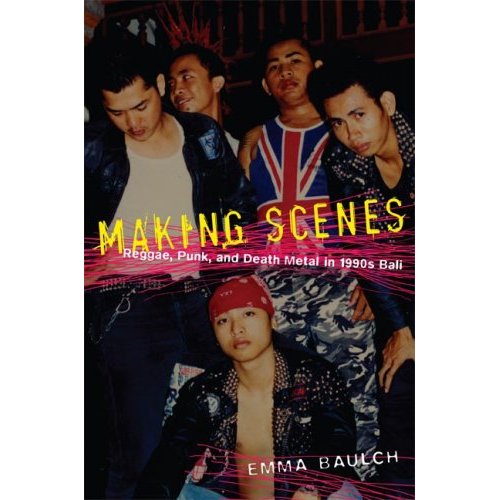
Making Scenes: Reggae, Punk, and Death Metal in 1990s Bali
by Emma Baulch (Duke University Press, December 2007)

In 1996, Emma Baulch went to live in Bali to do research on youth culture. Her chats with young people led her to an enormously popular regular outdoor show dominated by local reggae, punk, and death metal bands. In this rich ethnography, she takes readers inside each scene: hanging out in the death metal scene among unemployed university graduates clad in black T-shirts and ragged jeans; in the punk scene among young men sporting mohawks, leather jackets, and hefty jackboots; and among the remnants of the local reggae scene in Kuta Beach, the island’s most renowned tourist area. Baulch tracks how each music scene arrived and grew in Bali, looking at such influences as the global extreme metal underground, MTV Asia, and the internationalization of Indonesia’s music industry.

Making Scenes is an exploration of the subtle politics of identity that took place within and among these scenes throughout the course of the 1990s. Participants in the different scenes often explained their interest in death metal, punk, or reggae in relation to broader ideas about what it meant to be Balinese, which reflected views about Bali’s tourism industry and the cultural dominance of Jakarta, Indonesia’s capital and largest city. Through dance, dress, claims to public spaces, and onstage performances, participants and enthusiasts reworked “Balinese-ness” by synthesizing global media, ideas of national belonging, and local identity politics. Making Scenes chronicles the creation of subcultures at a historical moment when media globalization and the gradual demise of the authoritarian Suharto regime coincided with revitalized, essentialist formulations of the Balinese self.

“Making Scenes is as good a balance of theoretical innovation, ethnographic observation, and musical ‘scene’ analysis as I have seen in a long time. It is also the best account I have seen of the international circulation of 1990s alternative U.S. rock outside the United States.” -Will Straw, author of Cyanide and Sin: Visualizing Crime in 50s America

“Timely and engaging, Making Scenes is a wonderful and needed contribution to scholarship on Bali, to debates over the relationship between Birmingham School cultural studies and the work of area studies, and to the transnational study of popular music.” – Laurie J. Sears, editor of Knowing Southeast Asian Subjects

Emma Baulch is a Senior Research Associate in the Creative Industries Faculty at the Queensland University of Technology in Brisbane, Australia.

For more information, please visit the publisher’s webpage.

Two more books: on popular culture in Indonesia and popular music in Austrailia

by sonicscape

I was informed that these books on popular music and popular culture were just published. It feels good to see many books on popular culture in/around Asia (and especially music) are coming out.

indonesia

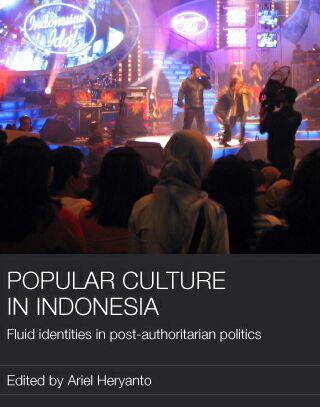
Popular Culture in Indonesia:
Fluid Identities in Post-Authoritarian Politics

Edited by Ariel Heryanto
Published by Routledge, 2008

One of the most significant results of the deepening industrialization in Southeast Asia since the 1980s has been the expansion of consumption and new forms of media, and that Indonesia is a prime example. Popular Culture in Indonesia; Fluid Identities in Post-Authoritarian Politics details the key trends since the collapse of the authoritarian Suharto regime (1998), showing how the multilayered and contradictory processes of identity formation in Indonesia are inextricably linked to popular culture. This is one of the first books on Indonesia’s media and popular culture in English; a significant addition to the literature on Asian popular culture.

For more information about this book, please visit:
http://users.tpg.com.au/arielh/popculture/index.htm

sounds_of_then

Sounds of then, sounds of now
Popular music in Australia

Edited by Shane Homan and Tony Mitchell
Hobart: ACYS Publishing, June 2008

In Sounds of then, sounds of now: Popular music in Australia some of the country’s most respected popular music researchers, musicians and music journalists document a range of past and present Australian sounds and scenes.

The collection maps recent changes in music consumption, production and media technologies, and the implications for local industries. It reconciles local music histories with contemporary practice, and reflects upon the growth and current diversity of Australian research, music genres and contexts, including jazz, rock, folk, metal, electronica, dance music, experimental music and hip hop. Chapters examining Aboriginal, Islander and world musics offer new perspectives on local and transnational relationships between popular music, geography and culture in Australia.

This text provides a means for understanding how popular music has expressed, reflected and influenced changes in Australian society through debates about youth, nationalism, censorship, local identity, contested spaces and enduring mythologies about ‘Australianness’. While some chapters examine earlier scenes and musical forms, the emphasis is upon Australian popular music since World War 2. At the same time, every chapter is informed by global debates and themes, including popular music’s ongoing concerns with concepts such as nationalism, cultural imperialism, globalisation, authenticity, appropriation, the ‘mainstream’, subcultures, genres and the impact of new media and the internet.

The authors’ considerable experience in teaching and researching popular music studies has ensured a collection that is lively, accessible and well adapted to use in media, popular music, sociology, musicology and cultural studies courses. Each chapter contains a reference list, discography, a list of key web sites and discussion questions to assist students in linking chapter themes and issues to wider national and international debates.

At a time when Australian popular music is enjoying increasing international critical and commercial success, this wide-ranging new collection offers a critical revision of popular music’s place in Australian society.

For more information: www.acys.info/publications/acyspublishing/music

Anthony’s new book

by sonicscape

Congratulations! Anthony Fung’s new book is finally out! Here is some information of his book. Please get your library have a couple of copies of this book.

anthony

Global capital, local culture: Transnational media corporations in China (Popular culture and everyday life)
by Anthony Y. H. Fung (Peter Lang, 2008)

Review
Anthony Y.H. Fungs study of the localization of transnational media in China is perceptive and fascinating. He writes with impressive insight and experience, as well as a good deal of enthusiasm for his subject. We not only learn about forms of entertainment media and popular culture in China after its entry into the WTO, but about how the cultural logic of political economy can be used to understand media. Fung has made a valuable contribution to the literature [on this subject]. –Janet Wasko, University of OregonThis book administers a much-needed antidote to some of the common myths about the politics underlying the marketization of the Chinese media industries in recent years. Drawing on extensive industry interviews, this book demonstrates the importance of taking an approach that, as Fung puts it, considers politics before economics in the study of the Chinese markets. This is a fundamental critique of the orthodoxies of globalization, which provides a highly nuanced understanding of the organization of media production and cultural consumption in China today.Graeme Turner, University of Queensland –Graeme Turner, University of Queensland

Product Description
This book examines the way transnational media companies have entered the Chinese entertainment market. Based on the authors ethnographic work and over 100 interviews with senior executives in global media corporations, including Warner Bros. Pictures, Viacoms MTV Channel, and Nickelodeon and News Corporations Channel V, the book analyzes the concrete globalization/localization strategies of these corporations and how they cope with the various political and economic constraints of working in China.

About the Author
Anthony Y.H. Fung is an associate professor in the School of Journalism and Communication at the Chinese University of Hong Kong. He received his Ph.D. from the School of Journalism and Mass Communication at the University of Minnesota. His research interests include political economy of transnational media corporations, popular culture, and cultural studies.