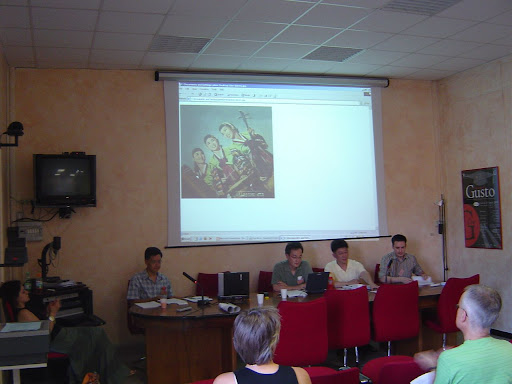
Imaging Community/Nation without (cultural) Borders: An International Conference on Inter Asian Culture, Communication, Conflict and Peace (Bangkok, July 28~29 2006)

by Homey81

Panel 6: Border-crossing Asian Cultural Economy

  • Korean Entertainment Companies in the Emerging Cultural Economy of Asian Pop

Shin Hyunjoon
Sungkonghoe University (Korea)

The discourses on popular music in Asia have been heavily associated with local politics within the boundary of a country (or a nation), focusing on generation, gender, race, ethnicity and, most of all, nationality. However, at least since late 1990s, border-crossing cultural flows have produced trans-Asian music culture which is beyond the control of national cultural policy, along with nationalist backlash against cultural trans-Asianism. This ambivalent phenomenon cannot be easily explained by the simple effects of cultural globalization. If there exits ‘Asian culture industry’ and/or ‘cultural economy of Asian pop’, how is and will be it transform popular culture in Asia? This paper attempts to analyze the process of the transformation from the perspective of political economy, focusing on ‘Asianizing’ strategies of Korean ‘entertainment companies’ and ‘content industry’.

  • Commodification of the Divided Korea – the case of Panmunjom Tour

Hirata Yukie
Yonsei University (Korea/Japan)

Panmunjon is the symbol of the divided Korea, which has established its status as a tourist spot for foreigners. Panmunjom means Joint Security Area(JSA) and is situated in the demilitarized zone separating North and South Korea. Since the UN force and Korean People’s Army guard the zone together, it is an excluded a north-south administrative district region. Panmunjon serves as the symbol of the tragedy of the divided Korea, the place in which separated families (risan kajok) gather, as the only passage, for various north-south political talks, and also has the duty as the educational spot which carries out security education to South Koreans. And for foreigners, Panmunjom is a popular tourist spot which gives ‘danger’ and strain. As globalization advances, touring outside the border is generalized increasingly. Panmunjom, where one can feel ‘danger’ easily, has a special aspect on that time and spatial meaning.
In this presentation, I will focus on Panmunjom as a tourist spot which has had such inconsistent and ironical duties. I will also examine what Panmunjom’s case shows to the global society, focusing on the process of being tourist spot, and the ‘national narrative’ which appeared in the process of commodification of the historical space symbolized as the Korean tragedy.

  • The Meaning of Screen Quota Cut and Movie Culture

Lee Jongnim
Sungkonghoe University (Korea)

This paper argues that FTA (Free-Trade Agreement) have effect on culture industry, especially film industry in Korea. The Screen Quota cut shocked the Korea public. Korean movies are very successful in numbers, far above the quota, and abolishing protectionism is always the right economic strategy. Screen Quota system has been a stumbling block between South Korea and U.S, who have been trying to conclude an FTA since 1999. The U.S. has been required the reduction of Screen Quota system as precondition to start an FTA with South Korea. However, the controversy over whether to reduce Screen Quota system or not has been continued. After all, Screen Quota system is reduced, Korean movie will be annihilated. therefore this debate is complicated. In order to solve this situation, analysis result to make discussion about that screen quota cut is connected with local movie culture or Asia culture and have a political significance.

Panel 7(a): Popular Music and Cultural Politics

  • From ‘Anti-China Invasion’ to ‘East-Core Asia’-The articulation of musical festival and politics in Taiwan

Ho Tunghung
Fo-Guang College (Taiwan)

Political engagement of popular music has long been thought as an essential form of cultural politics. Yet young people’s use of popular music as political expressions might vary in different socio-cultural and musical contexts. So in modern history, popular music might be articulated with anti-globalization actions, anti-authoritarian actions, anti- racism, anti-sexism, or even anti-Americanism. In our case, it is Taiwan-Chinese political tension on which this paper focuses.
Due to Taiwan’s particular political situation, pro-Taiwan independent(TI, hereafter)and anti-TI has fiercely confronted with each other for last two decades. The musical festival examined here is strongly recognized as pro- TI. But since its first launch, TRA, the independent musical organization, has changed its ‘politico-musical overtone’. From all- domestic bands to including East Asian(Japanese, Korean, ex-Chinese, and Singapore), US , and Australian bands to the festival, its core slogans, started as ‘Anti-China Invasion’, via ‘Say Yes To Taiwan’ to this year’s ‘East-Core Asia’ signals not only its practice of political rhetoric , but also its attempt to form a cross-national musical community.
Therefore, by studying this case, three key issues are explored:
1) To what extent can ‘music sound’ be voiced as pro-TI movement?
2) If as stated in this year’s pamphlet, democracy in Asia is the key issue while anti-China became implicit, then to what extent a cross-national boundary community can be achieved?
3) Above all, if music’s social force can travel national boundary, then to what extent the festival can be seen as a means to deal with TI ideology critically when it has been highly ethno-nationalist?

  • The Politics and Economics of Music: Case of Chinese Rock Music in Malaysia

Chan Lih Shing & Wang Lay Kim
Sains Universiti (Malaysia)

In 1986, the Home Ministry banned all open-air rock concerts. The authorities labeled such concerts as deviant. They particularly singled out Malay rock concerts arguing that such concerts transgressed the National Culture Policy. The National Culture Policy is based on the Malay culture, and Islam. However, in 2000, a transnational company sponsored a rock concert featuring a number of local groups that are popular with the youth were allowed to go on stage in Kuala Lumpur. It is apparent that policies are implemented inconsistently. It is in this backdrop this paper examines a local independent label rock group called Hung Huo. The group adopts a DIY (Do It Yourself) spirit to produce and distribute their own albums. This is a deliberate act on the part of the group to resist control by and dependence on big companies in the music industry. This paper will look at the political and economic factors that impinge on the development Huang Huo as well as their freedom to explore different musical styles.

  • “New Labour” or “New Elite”: Hybridizing Britpop in Thai Pop Culture

Viriya Sawangchot
Watanasala Centre for Cultural Studies (Thailand)

Britpop was a musical discourse rather than a genre as such and was born of both a frustration at the dominance of American bands in the British music scene of the early of 1990s in time of Conservative government in England. But following the collapse of the Conservative vote in the 1997 election, the Labour government announced the new formation of Britain economic policy by new labour concept “see the arts instrumentally as a means to help achieve of British life and social regeneration”. This economic policy emphasized certainly on export of Britpop’s use of national image as well.
As a musical discourse, Britpop rally around the world by hit bands and cool Medias. As a cultural discourse, Britpop cease to have defining effect upon ‘alternative life style’ of youth culture around the world. Within theses discourses, the new frontier of national and political ideology does not depend on state’s territory anymore. However, these discourses also draw new boundaries which become a battleground of border between national community and cosmopolitan.
In this paper, I would like to explore the significance of cultural hybridity of “TrueBrit” of Britpop in Thai Pop Culture, especially about politic of youth culture. The paper will also raise questions about the multi-cultural identities as well as the limits of imagined community in the complexity of global media culture.

  • Jazz and Giants of Jazz: The Dialectical Juxtaposition of a Pop Culture and the Mainstream

Chi Yu Chang
Ming-chuan University (Taiwan)

The jazz musicians of the United States have created a legacy of the American dreams. After scrutinizing Studs Terkel’s interpretation of early jazz masters’ life and work experiences, I find that the existing injustice and inequality aggravated by race, class, and gender biases seem irrelevant to or indecisive in one’s struggle for success or self-actualization. This does not necessarily mean that those negative factors are deliberately played down or ignored, or that the author’s viewpoints are based on white chauvinism. Rather, it implies, first, a common denominator—a list of values or/and personal qualities that are shared with whoever wishes to realize a dream; second, a cultural connotation of jazz as an art form beyond what it is—a symbol of faith, freedom, and possibilities; and third, a reminder that jazz, despite its pop nature for fun, exemplifies a professional field in which adventure and competition appear desirable to enterprising people when explored within the context of American culture. In short, jazz, in Terkel’s allusion, shows how and why social mobility intended for fame and finance can be achieved in a border-crossing effort, which are what this paper attempts to deal with.

Panel 7(b) Hip Hop and Youth Cultural Practices in Three East Asian Societies

  • What’s up Man!!: Voice of Da Resistance and Da Violence in Thai Hop-Hop Music

Kachachai Wichaidit
Chulalongkorn University

The purpose of this research is to study the use of Hip Hop music as a mode of expression for Thai Youth to representing ideology of resistance through youth culture in forms of Thai rap music. “Hip Hop music” or “Rap music” is one of elements in Hip Hop culture , which is the aspects of African-American youth culture originated in the Bronx ,New York ,during the mid-1970s. Today Hip Hop music is very popular over the world and it also rework as a mode of expression for a range of local issues. Hip Hop music is a symbolic of resistance musicThis study will survey the character of Thai Hip Hop music and the Hip Hop scene in Thailand by using of documentary research and observations. In this study will representing the origin of African-American Hip Hop culture, the diffusion of Hip Hop culture around the world , the use of Hip Hop music as a tool to display the ideologies of youths , the development of hip hop music in Thai society and the ideology and the points of view of Thai youths to the society that are presented through hip hop music.

  • Racing Late Modernity in Taiwan Streets: Beat, Time, and Hip-Hop Dance Communities

Yuh-jen Lu
Shih Chien University

This project explores a theoretical perspective for Hip-Hop dance practice from bottom up, that is concerned with an alternative “civil society” and an act of community consciousness in Taiwan. It proposes to study the dance genre commonly labeled as a subculture of young generations with a particular focus on the production of “biao-wu” (dance-racing)-a combination of velocity, violence, and dancing pleasure in relation to late modernity. Given that Pop culture’s edge is often shifting, this study will correlate Zygmun Bauman’s liquid modernity with a critical view on consumerism and mass media, which will offer a new matrix for a reconfiguration of subject, dance and community. In the sense of racing, what cultural meaning of modernity does Hip-hop street dance represent in Taiwan? If street dance is a community act of hip-hoppers, then what does it accomplish? How has the trajectory of Hip-Hop dance complicated in relationship to the development of contemporary politics, media, marketing, mainstream dance and subculture in Taiwan? What role(s) does Taiwanese hip-hop community play in conjunction with globalization? Why do Taiwanese hip-hoppers construct their own autonomy or independence from elsewhere? It seems that the Taiwanese Hip-Hop dance is professionalized through media, what if the mass media simply lost their interests toward street dance?

  • Hip Hop in Hong Kong: Cantonese Verbal Art in the Articulation of Youthful Defiant Voices and Identities

Angel M.Y. Lin
The Chinese University of Hong Kong

Making local hip hop music and lyrics in Hong Kong has always been a marginal practice engaged in mostly by grass-root youths who find in this music genre and this trans-local sub-culture the powerful symbolisms to express their defiant voices to mainstream society. These Hong Kong youths express in their local language—Cantonese—rap lyrics their sharp critique of society, of the education system, and of what they see as mainstream hypocritical practices and overly commercialized mass media practices. Through using Cantonese raps in artful and witty ways they construct alternative discursive spaces where their defiant voices and sharp social critique can be heard in a fun yet powerful way. In this paper I shall draw on interviews of an influential Hong Kong hip hop MC—MC Yan of the former popular Hong Kong band, LMF (LazyMuthaFuckaz), and analysis of his hip hop lyrics to discuss how some youths in Hong Kong construct their powerful voices and identities in pockets of alternative spaces in a society that privileges the middle classes with their cultural capital, and in an education system where the local language of Cantonese is placed at the bottom of the linguistic hierarchy.

Association for Cultural Studies “Crossroads 2006″ Conference (Istanbul, July 20~23, 2006)

by Homey81

Panel title: Asian Pop Music Culture I: The Emerging Subjectivities and Asian Identities

Music Consumption and Cultural Identity: a case study of Jay’s fandom in China

Anthony Fung
The Chinese University of Hong Kong

This paper attempts to investigate the fandom and fans of one the most famous Chinese music artist Jay Chou, the interaction among which has reflected significant changes of the youth culture and cultural identity. Based on an ethnographic study of the fandom, we found that youth crystallized a new identity, very much Chinese but a modern one with Jay Chou’s imagination. Popular culture produced out of Jay’s fandom have provided resources for fans to articulate and explore their identity, which is an emergence of subjective and expressive individualism in response to the ideological frame of communist regime. However, such formation of identity is not entirely against the state, and on the contrary, the authorities took the advantage to co-opt the youth individualism into the state discourse to create a new national identity for the public.
Informal Cultural and Artistic Education in the New Media:

Communities of Independent On-line Musicians in Hong Kong

Angel Lin
Faculty of EducationChinese University of Hong Kong

King-Kui Cheung
City University of Hong Kong

In June 2005, an on-line Cantonese song 《他約我去迪士尼》(“He invites me to the Disneyland” ), composed and sung by a 19-year-old Hong Kong high school girl, Kellyjackie, became a hit song first on the Internet and then on all major Hong Kong radio channels.  Kellyjackie is one of the many young people in Hong Kong who have been participating in on-line communities of independent artists, who regularly upload their music, lyrics and songs onto these free-of-charge, music-sharing, Internet sites for publicizing and giving feedback to one another’s creative works.  Young musical talents are being groomed in such informal communities of practice spontaneously formed on the weblog sites. In this paper an ethnographic study of the music-making/sharing activities of these indie on-line communities will be presented.  Data from interviews of some of these indie artists will also be presented to explore both the potential impact of these communities on the creative media industries in Hong Kong as well as the implications for informal cultural and artistic education of young people in Hong Kong.

Shifting music technology, changing cultural identities: Internet and everyday music practices in Korea

Jung-yup Lee
University of Massachusetts, Amherst

In this paper, I explore the recent changes in digital technology of music and its cultural implication. New consumer technology of music, especially the internet is enormously changing the everyday music experiences. In Korea, it has become everyday cultural practices for internet users to make their own personal web pages using web templets such as “mini hompy” and “blog” provided by various internet service companies. Music using on the web seems a new way of experiencing not only music but also self and others, and defining and redefining identities. The analytic focus will be on the way personal and collective identities are sought and constructed through internet music practices. By showing different ways the music is used to build identities on the web homepages, I also identify the way business practices of internet companies frame and restrict the homepage users’ music practices, and relate it to the different use of music and different cultural identities.

Panel Title: Asian Pop Music Culture II: The Asian Cultural Flow

Cosplay fans of visual J-rock: Beyond the boundaries
Kyoko Koizumi

Aichi University of Teacher Education (Japan)

Visual J-rock enjoyed its heyday in the 1990s in Japan. Though the boom of visual rock bands themselves is passé, ‘cosplay’, a fan’s practice of visual J-rock is still visible at comic markets or cosplay gatherings. Even in the West Coast in the US, an increasing number of cosplay fans are paying attention to visual J-rock and the Internet shows us how networks through websites on band cosplay fans are well expanded across Asian countries. Using the data collected from my fieldwork on cosplay gatherings in Japan and San Francisco, and from the websites as well as through exchanging emails with cosplay fans, I will analyse in what ways cosplay fans are successful in going beyond various existing boundaries – between countries, sexualities and cultural genres.

Music can break the language barrior?: J-pop translated by chinese

Motoko Yabuki
Osaka University (Japan)

Since the late 1990’s, Japanese popular culture has been exported to several countries and had a popularity among young people. Until then, Japan did nothing but import foreign culture from many countries, this phenomenon was a novel movement. Japanese popular music, so-called J-pop, also has been accepted in East Asian countries and regions,especially Taiwan and Hong Kong. It can be found the factors of that movement, for example, major CD shops, Karaoke, Japanese TV program, internet, etc.. This paper, however, focuses on analyzing cover songs to explain the background of Japanese popular music in Mailand China and Taiwan. The cover songs, that Chinese words add to Japanese melody, have continued existing after WWⅡ until now. I will mention the change of the meaning of cover songs and the present state of affairs.

Regionalizing Local Popular Music: K-pop in Pop Asianism

Hyunjoon Shin
Sungkonghoe University (Korea)

Asian pop is a recent category, designating popular music produced and consumed across Asian Region. K-pop, standing for ‘Korean pop’ is the latest hot trend of Asian pop coming out of Korea. Korean pop which had been basically local or national in many senses, has begun to cross the borders and be integrated to Asian pop or pop Asianism since mid-1990s. As one component of so-called ‘Korean Wave’, K-pop has been popularized in different Asian societies. This paper attempts to analyze different meanings of K-pop in different local contexts. Focusing on the strategies of music industry and the imaginations of audiences, this paper will try to map out how far the integration of Asian pop has progressed and reveal the cultural transformation of Asian popular culture by combined effects of Asianization(globalization) and digitalization. In doing so, it will approach the problem of new emerging subjectivity of Asians.

IASPM 13th Biennial Conference (Rome, July 24~30 2005)

by Homey81

In July 2005, just after Inter-Asia Cultural Studies conference, Hyunjoon and Jungyup flew to Rome with Jung-yup. Pilho Kim took pains to organize a panel about Korean popular music (see below) and another Korean scholar called Roh Jaeho was adde up to our panel.

There we met some researchers from other parts of Asia like Yiufai and Waichung (who are our members), and also other researchers from Taiwan, the Philippines with whom I lost the contact. We also met Western researchers who has been studying Asian popular music, for example Jeroen de Kloet (on Chinese rock music), Stephanie Dorin (on Indian rock music) and Shirley Brunt (on Japanese song competition).

For more pictures, please click…

2005. 07. 25 ~ 29

After the conference, Tunghung said that he would have liked to read the conference book. So I scanned all the pages (as you know, sometimes I become crazy, haha) and send them to him. And I hope we all share them now.

After the conference I wrote conference review with the help of Pilho and it was published in the journal of Popular Music. If your university provides e-journal service, please download it here: http://journals.cambridge.org/production/action/cjoGetFulltext?fulltextid=408270. If not, just feel free to tell me.

(HJ)

Panel Proposal for the 13th Biennial IASPM International Conference
Popular music as ‘postcolonial’ transculture: the case of South Korea

Intended stream: Mapping Meaning

Organizer

Pil Ho Kim, Ph.D. candidate, sociology, University of Wisconsin-Madison, USA

Postal address: 138 Price Ave. Columbus, OH 43201, USA

Email: pkim@ssc.wisc.edu

Panelists

Roald Maliangkay (Ph.D. history, University of Amsterdam, The Netherlands): “Brothers and Sisters Join Forces: The Influence of American Military Entertainment on Korean Pop in the 1950s and early 60s”

Pil Ho Kim: “The Birth of ROK (Rock Of Korea), 1964-1972”

Hyunjoon Shin (Ph.D. economics, SongGongHoe University, Korea): “The (D)evolution of K-pop: from Americanization to Nationalization/Asianization?”

Abstract

This panel will investigate the process of localization/transculturation of popular music in South Korea as a consequence of the US military occupation and continued presence since the end of World War II. The military bases were a brooding ground for the local musicians, who were hired by the US authorities to provide entertainment for the soldiers and military personnel. Although these local bands basically copied Anglo-American popular music on the stage of military clubs and camp shows, at least some of them proved to be much more than just ‘cover bands’ when they found an opportunity to play their originals in front of the domestic audiences, a new generation of youths that grew up listening to the western pop music.

As early as the mid-1960s in South Korea, rock music became localized and representative of the burgeoning youth culture. In the beginning, rock music might have been a part of the American imperialist apparatus, or an emblem of cultural imperialism itself. But by the time, Korean rock was no longer associated with the US military.    While it is probably foolhardy to deny any kind of Anglo-American influence in today’s Korean popular music, the thoroughly localized context requires a more nuanced approach than presupposing a simple one-way cultural domination.

Another case in point is recent popularity of K-Pop, the localized version of western pop music, among the neighboring countries of East Asia. It is a prime example of how the global cultural hegemony is translated into a regional/national system of cultural industries. It also shows that popular music offers a good point of entry for the ‘postcolonial’ perspective in South Korea and the other parts of East Asia, which have been sharing much in common under the Japanese colonial rule and the subsequent US hegemony in the past and present.

Inter-Asia Cultural Studies Society 2005 Seoul Conference (1 panel and pre-conference) (Seoul, July 22~24 2005)

by Homey81

Translocal and A-national Politics in Asian Pop Music

Date: July 21, 2-6pm

Place: MediAct Conference Room, 5th Floor, at Ilmin Museum of Art

Host: Institute for East Asian Studies at Sungkonghoe University

Sponsor: The Korean Culture & Arts Foundation

2:00-2:50

K-Pop: From Americanization to Asianization

Shin Hyunjoon ( Sungkonghoe University, Seoul , Korea)

Nationalism in Japanese Hip Hop

Ogura Toshimaru ( Toyama University, Toyama , Japan)

The Emerging (National) Popular Music Culture in China

Anthony Fung (Chinese University of Hong Kong , Hong Kong)

3:00-3:50

The Practice of an Independent Label and the Localizing Aglo-American Practices: The Case of Crystal Records

Ho Tunghung (Fo-Guang College, Ilan, Taiwan)

Problematizing the Popular: The Dynamics between Pinoy Pop Music and Popular Protest Music

Teresita G. Maceda (University of the Philippines , Quezon City, Philippines )

4:00-4:50

Mainstreaming Asian Pop: Thai youth and K-pop consumption

Ubonrat Siriyuvasak (Chulalogkorn University, Bangkok , Thailand)

Shin Hyunjoon (Sungkonghoe University, Seoul , Korea)

The Construction and Circulation of the Social Imaginary of Ideal Femininity in Pop Music and Movies: The Trans-border Appeal of Chelsia Chan (Jin Chu-ha) in the 1970s

Angel Lin ( City University of Hong Kong , Hong Kong)

5:00-5:50 Overall Discussion

More pictures are at

2005. 7. 21 ~ 22 Inter-Asia Cultural Studies conference

Ubonrat, Anthony, Tunghung, Ogura and Jung-yup, didn’t we look much younger than now? I hope you also remember that we also had fun watching music show after the conference.

Sangnam Forum International Conference (Seoul, June 22 2005)

by Homey81


 Sangnam Forum International Conference

History and Present of Popular Music in Asia

June 22, 2005

Sangnam Institute of Management, Rosewood Room(2nd Floor)

Center for Management of Arts and Culture, Yonsei Business Research Institute

Organizers: Shin Dongyub(Yonsei University ), Han Joon(Yonsei University ),

Shin Hyunjoon(Sungkonghoe University )

Program / Contents
Register (9:20-9:50 )

Keynote Address (9:50 :-10:00 )

OH Se-Jo(Director, Yonsei Business Research Institute, Yonsei University , Seoul, Korea) – Opening Speech

HOSOKAWA Shuhei(International Research Center for Japanese Studies, Kyoto, Japan ) – Keynote Speech “History and Present of Popular Music in East Asia”

Session 1: Popular Music and Music Industry in Early to Mid 20th Century Japan and Korea( 10:00-11:50)

ZHANG Eu-Jeong (Seoul National University , Seoul, Korea) – ” The Quest for Lost Songs : The Formation and Development of Korean Popular Music in the First Half of t he 20th century ”

YAMAUCHI Fumitaka(The Academy of Korean Studies) – ” Japanese and Korean Historiography on Recording Industry in Early 20th Century ”

HOSOKAWA Shuhei(International Research Center for Japanese Studies, Kyoto, Japan) – ” Rock and National Language: The Japanese Case”

Lunch (11:50-12:40 )

Mini Concert (12:40-13:10 )

Session 2: Rock Music by Asians and Asian-americans(13:10-15:00 )

HO Tung-Hung (Fo Guang College, Ilan, Taiwan) – “The Creation of the Anglophone M usic Scene : F rom the 1950s to the mid-1970s”

SHIN Hyun-Joon ( Sungkonghoe University , Seoul, Korea) – “The Rise and Fall of Korean Rock, 1964~1975: Americanization and Glocalization of Group Sound Rock Music”

Eric CARUNCHO(Music Critic, Quezon City , The Philippines) – “From Genesis to Revelations: : A mythic Journey Through Pinoy Rock & Roll ”

KIM Pil-Ho ( University of Wisconsin-Madison, Wisconsin, USA) – “Little Chang Big City: Asians in American Independent Rock”

Coffee Break(15:00-15:10 )

Session 3: Asian Pop?: Americanization, Anti-americanization and Beyond (15:10-17:00 )

Lamnao EAMSA -ARD (Rajabhat Pibulsongkram University , Phisanulok , Thailand ) – ” ‘Song for Life’: From Protest Music to Pop Rock”

KIM Hyu ng-Chan (Popular Music Scholar) – “The R eception of American Modern Folk M usic in Korea: From ” Folk” to “T ong-Gita Music””

Angel LIN (練美兒)(C ity University of Hong Kong, Hong Kong) – “Images of Gender and Gender Relations in Hong Kong Canton Pop Songs: Analysis of Lyrics of Seven Top Stars in the 1980s-1990s( 香港 粵語流行曲的兩性形象和兩性關係: 七位流行歌手的歌詞分析)”

Session 4: Roundtable: The Task and Future of Asian Pop and Music Industry (17:00-17:50 )

All Participants

Reception (18:00-19:30)

* Discussants, moderators, and facilitators other than presenters : Fang-Chih Yang(National Dong Hwa University, Taiwan), MC Yan(Musician, Hong Kong), KIM Dong-Hun(Yonsei University), KIM Eun-Mi(Yonsei University), KIM Jin-Wu(Yonsei University), KIM Chang-Nam( Sungkonghoe University ), PARK Ae-Kyung(Yonsei University), SHIN Dong-Yub(Yonsei University), LEE Kee-Hyeung(Kyunghee University), CHANG Jin-Ho(Yonsei University), HAN Dong-Huhn(Representative of Ales Music, Seoul), HAN Joon(Yonsei University)

For more pictures, click the picture below

2005. 06. 22 Sangnam Forum