DOWNLOAD LINK: IAPMS-2014-Program_0717
HOTEL INFO: THE 4TH INTER-ASIA POPULAR MUSIC STUDIES CONFERENCE 2014
Hello all~
If you are looking for accommodation nearby the 2014 IAPMS Conference venue, CMU, please check out the list below. You can also find so many hotels in downtown Chiang Mai through major hotel booking services, such as Agoda.com/ Chiang Mai, or Tripadvisor.com/Chiang Mai.
Inter-asia pop has posted a new item, ‘Hotels and Hostels nearby 2014 IAPMS Conference Venue’
The hotel was listed according to their room rate which should check directly through their websites.
Mid-range Hotels
Kantary Hills, Chiang Mai
Address:44, 44/1-2 Nimmanhaemin Road, Soi 12, Suthep,
Muang, Chiang Mai 50200, Thailand.
Tel: +66 (0)53 22 2111, +66 (0)53 40 0877
Fax: +66 (0)53 22 3244
e-mail: reservations@kantaryhills-chiangmai.com
Web: http://www.kantarygroup.com/kantaryhills-chiangmai/location.html#
Amari Rincome Hotel
Address:1 Nimmanhemin Rd.T. Suthep A. Muang Chiang Mai 50200 Thailand
Telephone: +66 (0)53 894884 93, +66 (0)53 22 1915
Email: rincome@amari.com
http://www.amari.com/
Chiang Mai Hill Hotel
Address:18 Huai Kaew Rd. T. Suthep A. Muang Chiang Mai 50200 Thailand
Telephone: +66(0)53-210030-4, +66(0)53 21 5958
Fax: +66(0)53-210035
http://www.chiangmaihillhotel.com/
Lotus Pangsuankaew
Address:54 HuayKeaw Road, Muang Chiang Mai 50300
Phone: +66(0)53 224 333
http://www.lotuspskhotel.com/index.php/th/
Nimmanmai Design Hotel
Address: Nimmanheamin-Sukasem Road, Suthep, Muang, Chiangmai 50200 Thailand
Tel. +66 (0)53 400 567
http://www.nimmanmaihotel.com/index.php
The Empire Residence Nimman
Address: 22/3 Nimmanhemin Road, Sutep, Muang, Chiang Mai, Thailand
Phone: +66(0)53 28 9288
http://www.empirenimman.com/
Budget Hotel
Sinthana Resort Chiang Mai:
www.sinthanaresortcm.com/
Sirinart Garden:
http://www.sirinartgarden.com/
Chiang Mai University UNISERV Hostel
http://www.uniserv.cmu.ac.th/engweb/index.html
[CFP] 18th Biennial IASPM Conference
Call for papers
Back to the Future: Popular Music and Time
18th Biennial IASPM Conference
29 June – 3 July 2015
Universidade Estadual de Campinas
São Paulo, Brazil
*Versão em português abaixo*
*Versión en español abajo*
Whether in relation to rhythms, eras, live performances, lyrics, identities, politics, scenes, production, or changing technologies, the topic of time can be linked to popular music in a variety of ways. The compartmentalising of sounds into genres, the ageing of audiences, and the shifting sands of the music industry all invoke notions of the temporal. For the 18th Biennial IASPM Conference, we invite researchers and practitioners to submit proposals for presentations that engage with the theme of time. We encourage proposals dealing with one of the following strands:
– Ageing Times: fandom and memory; musicians’ biographies; archiving and remastering; ageing bodies; ageing technologies; recycling repertoires.
– Historical and Social Times: contextual times; local and global histories and counter-histories; fashion, retro and revival trends; timelessness; sampling and other forms of sonic genealogies, re-circulations and surrogations.
– Modern Times: new sounds; new technologies; futurism; music industry strategies; mobile media.
– Phenomenological Times: creative process; performance deployment; gesture, affect and listening experience; cross time productions, collaborations and performances.
– Structural Times: rhythm, tempo, groove, swing, beat and the various ways of conceptualizing the duration of sound; periodicity and repetition; flow and cadence; being in/out of time and sync; relationships between noise and silence(s).
There will be the options of: panels (of 3 or 4 presenters), individual papers, film/video presentations, or poster sessions.
Panels
Proposals of organized panels are strongly recommended (two-hour long sessions with four papers, or three papers and a discussant). Each session should leave at least 30 minutes for discussion or for comments by a discussant immediately following the presentations. The panel organizer should submit the panel abstract and all individual abstracts (200 words each) in one document, with a full list of participant names and email addresses. Where an independently submitted abstract appears to fit a panel, the Academic Committee may suggest the addition of a panelist.
Papers
We invite abstracts of no longer than 200 words, including five keywords for programming purposes. Individual paper presentations are 20 minutes long to be followed by 10 minutes of discussion.
Film/video session
Recently completed films introduced by their author and discussed by conference participants may be proposed. Submit a 200-word abstract including titles, subjects, and formats, and indicate the duration of the proposed films/videos and introduction/discussion.
Poster session
A space where presenters can exhibit posters, that remain on hand for a scheduled period for discussion, will be provided. A 200-word abstract by the poster’s author, including five keywords for programming purposes, must be submitted.
Submission
Please email your abstract as a Word doc attachment to iaspm15[at]iaspm.net. Please name the file with your surname. The following format should be used:
– Name, affiliation and contact email address
– Type of presentation (select one from: panel, individual paper, film/video, poster)
– Title of presentation (and panel if applicable)
– Strand (select one from: Ageing Times / Historical and Social Times / Modern Times / Phenomenological Times / Structural Times)
– Abstract
– Five keywords
– Bio (80 words maximum)
Papers will be accepted in English, IASPM’s official language, and Portuguese and Spanish, IASPM Latin America’s official languages. For submissions in Portuguese and Spanish, an additional abstract in English is required, and, if selected, an English visual presentation is to be screened while presenting.
Questions about the organization of panels should be directed to the Chair of the Academic Committee, Goffredo Plastino: chair[at]iaspm.net. Suggestions for other possible events at the Conference should be directed to the Chair of the local Organizing Committee, Rafael dos Santos: rdsantos[at]unicamp.br
Each participant must be a member of IASPM:http://www.iaspm.net/how-to-join. Each participant may present only one paper at the Conference, but may also preside over a panel or serve as a discussant.
Deadlines
Deadline for receiving abstracts: 31 May 2014
Acceptance/rejection letters: 30 September 2014
Opening registration: 1 October 2014
Deadline for “early bird” registration (US$ 150): 1 February 2015
Program draft: 1 March 2015
Conference fee payment deadline (US$ 200): 2 April 2015
Final program: 31 May 2015
CFP: The 4th Inter-Asia Popular Music Studies Conference 2014 in Chiang Mai (Thailand)
CFP: The 4th Inter-Asia Popular Music Studies Conference2014 in Chiang Mai (Thailand)
Date: 8-9 August 2014, (Friday-Saturday)
Venue: College of Arts, Media and Technology, Chiang Mai University, Chiang Mai, Thailand
Campus Map: http://www.camt.cmu.ac.th/en/contact.php
Organized by:
Inter-Asia Popular Music Studies Group (IAPMS group),
College of Arts, Media and Technology, Chiang Mai, Thailand
Statement
We are pleased to announce the 4th Inter-Asia Popular Music Studies Conference, which will take place on August 8-9, 2014 in Chiang Mai, in collaboration with College of Arts, Media and Technology, Chiang Mai University, Thailand. Following the first conference in Osaka in 2008, the second conference in Hong Kong in 2010, and the third conference in Taipei in 2012, we move our next meeting to Thailand—hub of vibrant Southeast Asian popular music and music industry.
Founded in 2008, Inter-Asia Popular Music Studies Group (IAPMS group) is a research network that at the moment includes 120 scholars not only in Asia but also in Europe, America and Oceania. Through its biennial conferences and related activities, the group provides a platform to foster scholarly conversations and collaborations arising from the growing academic interest in Asian popular music both inside and outside Asia.
CONFERENCE THEME (IAPMS∙2014∙Chiang Mai):
How to Perform‘Inter-Asia’Popular MusicStudies
Nowadays, Asian popular music is strong and serious investigation on it is growing, in the academy and elsewhere. More importantly, the cultural economy of popular music in Asia has become transnational or border-crossing in a literal sense. There are quite a few case studies that show that the consumption and mediation as well as the production and distribution easily cross national borders.
However, most of ‘inter-Asia’ popular music studies restrict themselves to a ‘national’ base. Most researchers are specialized in the popular music of one nation or language group and it has proven to be quite a challenge to adopt a truly ‘inter-Asia’ perspective. This perspective of comparative or cross-cultural research is unfortunately still a somewhat distant ideal, with only a handful successful texts that light the way. Given this situation, is it enough for each researcher to write about his/her ‘own’ music and leave the comparison to the readers of a ‘special issue’ or ‘edited volume’ that covers different ‘cases’? Or should we rather find out a‘collective’ or ‘collaborative’ approach to doing research and writing papers? How can it be done, when you do not have sufficient international connections, when there is no agreed upon vocabulary and periodization, when your time schedule or life cycle does not match? Finally, is collective or collaborative writing really necessary?
The 4th Inter-Asia Popular Music Studies conference will address the possibilities and difficulties of adopting an ‘inter-Asia’ perspective. We especially welcome papers that consider comparative and/or collaborative research, in the future as well as in the present. The conference engages with all the scholarly debates of the emerging fields of Inter-Asia popular music studies, in the following categories or streams:
Stream 1: Theory and Methodology
Stream 2: Production, Circulation and Consumption
Stream 3: History,Geography, Politics
Stream 4: Genre, Identity, Ideology
The organizer of Inter-Asia Popular Music Studies Conference 2014 in Chiang Mai would like to invite paper presenters to send their abstract (not more than 250 words) to iapms2014chiangmai@gmail.com before 25 January 2014. Please don’t forget to write down the ‘stream’ in which you think your paper fits.
Please use the attached Proposal Form (right click to download) when submitting your proposal. Please use your surname as file name (ex. Chua.doc, Douglas.doc). If you plan to organize a panel with more than two people, please coordinate with the panelists to put all the necessary information on one form (e.g., panel title, paper titles, individual abstracts, panelists information). A panel description is not necessary.
Please email all inquiries to: iapms2014chiangmai@gmail.com
2014.1.25 Deadline for abstract submission
2014.02.25 Acceptance of papers
2014.04.25 Registration
2014.07.25 Submission of full paper
2014.08.08-09 Conference Days
Steering Committees
Viriya Sawangchot (API Fellow & Mahidol University, Thailand)
Siriporn Somboonbooran (Walailak University, Thailand)
Atchareeya Saisin (Chiang Mai University, Thailand)
Pitipong Yodmongkol (CAMT, Chiang Mai University)
Napaporn Reeveerakul (CAMT, Chiang Mai University)
Sumet Yodkaew (CAMT, Chiang Mai University)
Organizing Committees
Tunghung HO (Fu-jen Catholic University, Taiwan)
Eva TSAI (National Taiwan Normal University, Taiwan)
Anthony FUNG (Chinese University, Hong Kong/China)
Yoshitaka MORI (Tokyo University of the Arts, Japan)
Jeroen Groenwegen-Lau (Independent scholar, Netherlands-China)
Yukie HIRATA (Dokkyo University, Japan)
Sun JUNG (National University of Singapore, Singapore)
Kai Khiun LIEW (Nanyang Technological University, Singapore)
Aekyung PARK (Yonsei University, Korea)
Hyunjoon SHIN (Sungkonghoe University, Korea)
Jung-yup LEE (University of Massachusetts Amherst, USA/Korea)
Notes
English is the only language in the conference as there is no common language among Asia language. Translation service can be provided only during Q&A, in case the presenters need it.
For the updated information about submission, registration, accommodation, transportation etc, please keep visiting our website: http:www.interasiapop.org.
Music Festival Boom in Korea
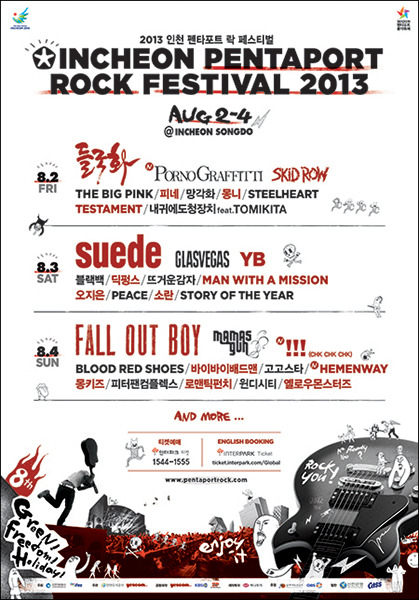
Until the 1990s, music festivals were unimaginable to locals Korean music fans. A couple of festivals have begun to be organized after the mid-1990s and it has grown into a big business since the mid-2000s. The year 2013 would be the peak of the festival boom. Yearlong fests are going on smooth and the new ones are still emerging. About the list of the festivals between March and August this year, see below. While some are international ones, while others are largely local. That’s why some have English websites, wile others are not.
What kinds of music are there? There are different genres/styles in different festivals: pop, rock, jazz, electronica etc. But the most popular ones in the local festivals would be ‘indie pop/rock,’ which is not-so-popular to international ‘K-pop’ fandom. You can check how it sounds in the website of one of the (local) festivals in May: Greenplugged Fastival (http://greenplugged.com: above is the poster). Although there are clash of schedule with two other festivals (!), the two-days tickets are sold-out already.
I wonder if something similar is going on in other parts of Asia. If so (with differences in many respects, of course), it needs to be under serious investigation and discussion. One thing I can say for sure at this moment is that ‘live music’ is becoming more important than ‘recorded music’ for non-mainstream Korean pop musicians and their fans. But that would not be the whole story. Any information we can share? (HJ)
<Music Festivals in Korea in 2013>
| Seoul Live Music Festa Vol.14 | March 30 | 5 theaters in Hongdae, Seoul-si |
| Beautiful Mint Life 2013 | April 27,28 | Goyang Aram Nuri, Ilsan |
| Metal Fest 2013 | May 9 | Olympic Hall, Olympic Park, Seoul-si |
| Seoul Jazz Festival 2013 | May 17,18 | Olympic Park, Seoul-si |
| Jarasum Rhythm & BBQ Festival | May 17,18 | Jarasum, Gapyeong-gun Gyeonggi-do |
| Green Plugged Seoul 2013 | May 17,18 | Nanji Hangang Park, Seoul-si |
| 2013 World DJ Festival | May 17-19 | Narukke Festival Park (나루께축제공원), Yangpyeong-gun Gyeonggi-do |
| Rainbow Island 2013 | June 7-9 | Namiseom Island, Gapyeong-gun Gyeonggi-do |
| Ultra Korea 2013 | June 14,15 | Olympic Park Stadium, Seoul-si |
| Muse in City | June 15 | Olympic Park, Seoul-si |
| 2013 Ansan Valley Rock Festival | July 26-28 | Daebu Sea Breeze Theme Park (대부바다향기테마파크), Ansan-si, Gyeonggi-do |
| Jisan World Rock Festival | August 2-4 | Jisan Valley Ski Resort, Icheon-si, Gyeonggi-do |
| Incheon Pentaport Rock Festival | August 2-4 | Songdo International city, Incheon-si |
| Super Sonic 2013 | August 14-16 | Olympic Park Seoul-si |
☞ Festival Homepages:
Seoul Live Music Festa: www.therolling.co.kr (Korean)
Beautiful Mint Life: www.mintpaper.com (Korean)
Green Plugged Seoul: http://greenplugged.com (Korean)
2013 World DJ Festival: http://worlddjfest.com (Korean, English)
Rainbow Island: http://rainbowfestival.co.kr (Korean)
Ultra Music Festival Korea www.umfkorea.com (Korean, English)
Ansan Valley Rock Festival: www.valleyrockfestival.com (Korean)
(source: http://english.visitkorea.or.kr/enu/FU/KTO_EN_15.jsp?cid=1799714)
☞ Reservations
[Metal Fest 2013] (English)
[Seoul Jazz Festival] (English)
[World DJ Festival] (English)
[Rainbow Island] (English)
How to Write Inter-Asia pop Studies Collectively: the Difficulties of Collaborative Research

How to Write Inter-Asia pop Studies Collectively: the Difficulties of Collaborative Research
Date: April 27 2013
Place: Michael Hall 301, Sungkonghoe University
Organized by: IEAS, Sungkonghoe University
* This workshop was supported by funding from KRF (Korea Research Foundation (KRF-2007–361–AM0005)
Inter-Asia Popular Music Studies Group (IAPMS group) is an offshoot of the Inter-Asia Cultural Studies Society (IACS) as well as the International Association for Study of Popular Music (IASPM). Since it was officially founded in 2008, three biennale conferences were held in Osaka (Japan), Hong Kong (China) and Taipei (Taiwan). There were other smaller meetings initiated by its members. Two special issues for the international journal Inter-Asia Cultural Studies (2009) and Popular Music (2012) came out through the collective efforts of the group.
All these achievements do not mean that the popular studies in the academia in Asian region have been firmly established in the academy. However, it cannot be denied that popular music has become one of important issues, when we discuss cultural, economic and political changes in Asia societies.
That being said, it can be easily agreed upon that the power of Asian popular music is strong these days and that the serious investigation on it is important even in the academy. More importantly, the cultural economy of popular music in Asia has become transnational or border-crossing in a literal sense. There are already quite a few case studies which show that the consumption and mediation as well as the production and distribution easily cross the national borders.
However, it should be confessed that most of ‘inter-Asia’ popular music studies have been performed on a ‘national’ base. Most of researchers are specialized in the popular music of one nation or language group and it is still confusing to write something under the banner of ‘inter-Asia.’ It is taken as ‘ideal’ to have comparative or cross-cultural perspective, but there are few which have done that. Then, is it enough that each researcher writes about his/her ‘own’ music and leave the comparison to the readers of ‘the special issue’ or ‘edited volume’ which covers different ‘cases’? Or should we find out a rather ‘collective’ or ‘collaborative’ way of doing the researches? How can it be done, when you do not have the international connection or when your time schedule or life cycle does not match? Finally, is collective or collaborative writing really necessary?
This workshop is organized to discuss the difficulties of ‘inter-Asia’ perspective. After each speaker will present his/her own case, the inter-Asia construction of the research will be discussed. Hopefully, it will be evolved into the work of publishing a book which will function as the textbook of inter-Asia popular music studies.
Organizer: Hyunjoon Shin (Sungkonghoe University) hyunjoon.shin@gmail.com
Assistant: Alina Barthuli (Sogang University) barthulina23@gmail.com
CFP on Feminist Hip Hop Scholarship
Subject: Call for Papers: “All Hail the Queenz: A Queer Feminist Recalibration of Hip Hop Scholarship”
Call for Papers:
“All Hail the Queenz: A Queer Feminist Recalibration of Hip Hop Scholarship”
A Special Issue of *Women and Performance: A Journal of Feminist Theory*.
Issue Guest Editors: Shanté Paradigm Smalls (University of New Mexico) and
Jessica N. Pabón (New York University)**
Submission deadline: *May 1, 2013*
*Women and Performance *invites submissions for a special issue, “All Hail
the Queenz: A Queer Feminist Recalibration of Hip Hop Scholarship.” The
editors welcome scholarly articles and performative texts that foreground
feminist and queer performance studies approaches to hip hop culture,
consumption, and production.
Contemporary rap music, as a stand-in for hip hop culture and production,
is virtually synonymous with misogyny and homophobia in the mainstream US
and academic imaginary. We want to explore the range of understandings and
theories that inform how women and queers experience hip hop culture and
performance; this issue underscores the multiplicity of hip hop culture and
rejects a myopic totalizing view of what “the culture” does and is. We seek
to engage with the wide range of hip hop scholars and practitioners working
at the intersections of various methodologies not always associated with
scholarly considerations of hip hop (including psychoanalysis, feminist and
queer theory, and performance theory), as well as methods typical to hip
hop studies—sociology, Black studies, literature, history, musicology, and
urban studies. An emerging class of hip hop scholars pressure the givens of
race, gender, performance, sexuality, region, nationality, artistry, and
iconography—as a culture that has been in a state of constant development
for the past forty years, hip hop scholarship is more than due for a queer
feminist remixing and reimagining.
As coeditors, we challenge the readers of *Women & Performance* to ask:
What would a specifically queer feminist performance studies approach to
hip hop’s culture and production generate in terms of scholarship? How does
a queer feminist experience and critique revise hip hop studies? Why has
performance studies had so little to say about hip hop, what interventions
does performance studies yield? The issue’s focus on producing knowledge
about hip hop culture that centralizes women, girls and queer people will
include a range of elements, both popular and subcultural: DJ culture,
dance, graffiti, human beat boxing, rap music, as well as fashion, media
and print, organizing, and other forms of knowledge production. No matter
the genre, hip hop is often conceived and misrepresented as a
male-dominated culture which casts women and girls as an addendum to hip
hop rather than as primary producers, critics, and consumers. Within the
pages of this issue, contributors revisit the centrality of feminist and
queer artists to the production of all elements of hip hop culture and of
feminist and queer critique to hip hop scholarship. “All Hail the Queenz”
intends to tease out the nuanced negotiations women, girls, and queer
people develop as hip hop artists, critics, and consumers participating
within this climate.
Through re-centering feminist and queer critiques and female and queer
performance, “All Hail the Queenz” recalibrates hip hop’s center. By
recalibrating the center, contributors to this issue refashion hip hop
historiography and hip hop aesthetics beyond the art of rapping by the
cisgendered male body. In a kind of textual reperformance, this issue takes
its title from Queen Latifah’s lyrical demands for respect on her first
womanist rap classic album, “All Hail the Queen,” and reminds readers once
again that “stereotypes, they got to go!”
Potential Topics:
– Alternate Hip Hop historiographies
– Artist Scholars
– DJing, technology, gender, sexuality
– Feminist, queer, trans* aesthetics
– Feminist, queer, trans* pedagogy
– Graffiti and gender/sexuality
– Hip Hop culture and dis/ability
– Hip Hop diasporas
– Hip Hop fashion
– Hip Hop feminism
– Hip Hop festivals
– Hip Hop’s hybridity
– Human Beatboxing
– Media culture and social networking
– Nation, Empire, and hip hop
– Queer feminist hip hop critique
– Queerness and/in/of hip hop
– Trans* in/and hip hop
Article submissions should be 6-8,000 words in length and adhere to the
current Chicago Manual of Style (CMS), author-date format. Performative
texts should be 2-3,000 words and in any style the author chooses (same CMS
style as above if using citations). Photo essays are welcome. Questions and
abstracts for review are welcome before the final deadline.
Complete essays and texts for consideration must be submitted by 11:59 PM
EST, May 1, 2013.
Please send all work to both Shanté Paradigm Smalls and Jessica N.
Pabón via email (MSWord attachment): shantesmalls@gmail.comand
jnp250@nyu.edu.
Further submission guidelines may be found at:
http://www.womenandperformance.org/submission.html. *Women and Performance* is a
peer reviewed journal published by Routledge, Taylor & Francis.
Thanks for circulating!
Best,
Jessica N. Pabón
ABD, Performance Studies New York University
American Association of University Women Dissertation Fellow, 2012-2013
Curator, bob bar gallery, NYC
Email: jnp250@nyu.edu
Blog: artofgettingovaries.wordpress.com
Facebook Page: http://www.facebook.com/ArtofGettingOvaries
TedxWomen Talk: http://tedxwomen.org/speakers/jessica-pabon/
A Korean translation of Popular Music in Theory by Keith Negus
by homey81
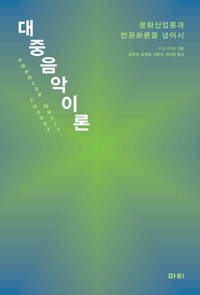
A Korean translation of Keith Negus’s canonical work Popular Music in Theory: An Introduction was out on August 31. The title of the Korean translation is, literally translating, Popular Music Thories: Beyond the theory of culture industry and that of countercultural theory (대중음악이론: 문화산업론과 반문화론을 넘어서). Translated by Hawsook Song et al and published by Matibook.
Table of contents is the same of English version.
Chapter 1 Audiences
Chapter 2 Industries
Chapter 3 Mediations
Chapter 4 Identities
Chapter 5 Histories
Cjapter 6 Geographies
Chapter 7 Politics
Best
Hyunjoon
Understanding Popular Music (An edited volume in Korean)

A textbook style edited volume about popular music studies was published some months ago. Edited by Chnagnam Kim (Sungkonghoe University), published by Hanul Academy. Only in Korean. Below is the table of contents which has been translated into English by myself. Please keep in mind that the Romanization of Korean names can be different.
Table of contents
01 Studying Popular Music – Changnam Kim
Part I; The production and reception of popular music
02 Popular music and industry – Jungyup Lee
03 Popular Music and technology – Byung-O Kim
04 Popular music and audience – Dongyeon Lee
Part II Popular Music and Society, Main Issues
05 Poplar music and geography, space and place – Hyunjoon Shin
06 Popular music and generation – Woojin Cha
07 Popular music and politics – Mingap Seojeong
08 Popular music and woman – Jisun Choi
Part III Popular Music Genres and Histories
09 The Beginning of Korean popular music: trot and new folk song – Junhee Lee
10 The formation and change of Korean-styled pop: Standard pop and ballad – Youngmee Lee
11 A Chronology of Korean folk and rock – Aekyung Park
12 ‘Black music’ in South Korea: Soul and hip-hop – Jaeyoung Yang
13 Music to watch, music of body – Eujeong Zhang
————–
01 대중음악 공부하기_김창남
제1부 대중음악의 생산과 수용
02 대중음악과 산업_이정엽
03 대중음악과 테크놀로지: 축음기에서 MP3까지_김병오
04 대중음악과 수용자_이동연
제2부 대중음악과 사회, 주요 논점들
05 대중음악과 지리, 공간, 장소_신현준
06 대중음악과 세대_차우진
07 대중음악과 정치_서정민갑
08 대중음악과 여성_최지선
제3부 대중음악의 주요 장르와 역사
09 한국 대중음악의 출발: 트로트와 신민요_이준희
10 한국식 팝의 형성과 변화: 스탠더드 팝과 발라드_이영미
11 한국 포크와 록의 연대기_박애경
12 한국의 흑인음악: 소울, 그리고 힙합_양재영
13 보는 음악, 몸의 음악: 댄스음악_장유정
Best
Hyunjoon
CFP: K-pop politics: digital mediation and global fandom
The K-pop frenzy is anything but ordinary. On May 1 this year, some 300 French fans holding Korean national flags gathered in front of the Louvre Museum, calling for additional K-pop concerts to be held in Paris. Similar rallies ensued in London’s Trafalgar Square, Poland’s Warsaw, and Colombia’s Bolívar Square.
Though on a continuum with Hallyu (the Korean Wave), K-Pop departs from the earlier waves of Korean popular culture in its media specificity, geographic scope and generational focus. Preceding currents of Korean popular culture had centered on the cult of Korean television dramas distributed through conventional mass media (terrestrial, satellite, and cable televisions) to neighboring countries such as Japan, China, Taiwan, Vietnam, etc. The K-pop craze, however, is beyond “Asian” bounds. This year alone, K-pop concerts were held in L.A., New York, Paris, London, Sydney, Tokyo, etc., and K-Pop flash mobs continue to take place in such metropolises as Singapore, Lima, Sao Paulo, Toronto, Jakarta, Vancouver, Dublin, Bergen, and Rome.
The global K-pop rage is concurrent with and indebted to the rise of portable devices and what are known as social media. The effect is noticeable in the increased focus on visual aspects of K-pop. For example, South Korean singer Psy’s comic music video “Gangnam Style” has gone viral since it was released on July 15. The video surpassed 100 million hits on You Tube as of Sept 4, 2012, marking it the most-viewed video in such a short period of time. Social media, or social networking services (SNS), play a critical role in this. Songs shared through SNS strengthen online camaraderie, empower those who upload or distribute them, all the while bringing visual and musical experiences on individuated media to a new level.
Catalyzed by Twitter, Facebook, You Tube and online fan club sites, K-pop has emerged as an unambiguous instance of global digital youth culture: a social media-friendly, fan/user-steered, and participation-conducive anthropological occurrence. A unique amalgamation of dance, storytelling, persona, costume play, music, and fashion show, K-pop epitomizes a meta-genre performance in its own right. Accordingly, the cultural ownership or origin/ality of K-pop becomes a moot question, as it consciously espouses a hybridized mode of production. A bold concoction of styles, tunes, and languages borrowed from Europe, America and Japan, K-pop has spawned abundance of derivative local cultures: cover dance competitions, club parties, and fan club conventions.
Despite the transnational thrust, a dominant mode of production in K-pop remains “Korean.” A legion of similar idol bands has cropped up in less than ten years, and they are invariably manufactured and merchandised by a few Korean entertainment agencies. It is often claimed that the omnipotence of those management giants smothers artistic agency with what is known as a “slave contract,” which has sparked major controversies over labor and human right issues of K-pop performers. Fans do chime in and “meddle” with the mis/management of the stars they root for, as attested by the passionate support for JYJ’s debut, a group that broke out of TVXQ. Keenly aware of the growing clout of global fans, the leading management moguls (SM, YG, and JYP) make desperate efforts to stay on good terms with the K-pop devotees.
Aside from the tension between producers and consumers, K-pop has enjoyed a long, unperturbed honeymoon with capital and state power. Since the late 1990s, when entertainment business as a whole was designated as a strategic industry for South Korea, the K-pop enterprise has been a faithful ally to the reign of capital, commodity, fame and nationalist ideology. More often than not, K-pop industry would act as a cheerleader for various state and market affairs in exchange for policy support from various state bureaus and lavish underwritings from conglomerates like Samsung and LG, IT behemoths seeking to cash in on the soaring value of the nation’s cultural capital. Complicit with this state-corporate joint maneuver are ordinary citizens, intellectuals, artists, and mainstream media, whose postcolonial aspiration to see the nation exit from cultural obscurity hazardously awakens nationalist urges intrinsic to the state and capital-led Hallyu/K-pop campaign.
All of the instances necessitate a rigorous politicization of the seemingly innocuous popular music vogue. Hence, the proposed volume asks: what political desire and historical impetus do we find from the unruly diffusion of K-pop; what cultural risks and social stakes do fans in Europe, North America, Latin America, and South East Asia have in espousing the popular culture from a cultural periphery; how is this related to the global disenfranchisement of the youth under the sway of neoliberalism, how does the rise of K-pop respond to global racism and/or cosmopolitanism in culture, and how does it help boost the visibility of ethnic/cultural minorities at large; in what ways does the instance of K-pop inform or contest the conceptual underpinnings of cultural imperialism, cultural globalization, hybridity, transnationalism and traveling culture; what forms of cultural interaction and alliance do social media galvanize through the viral dissemination of K-pop, and what types of cultural authority and social institutions do they play havoc with; how does the K-pop industry establish esthetic and affective connections with ethno-cultural and artistic communities in other parts of the world; what cultural effects does K-pop wreak on other popular cultures as well as on other music genres, domestically and internationally; what correlations or affinities are there between the composite esthetics of K-pop and new forms of communication afforded by social network services; and how does the mediated experience of K-pop facilitate transnational or local cultural practices in such fields as language acquisition, tourism, commodity consumption, plastic surgery, concert-going, friend-making, and so forth?
With these questions in mind, the volume seeks to bring together academic and professional writings on the following areas.
1. Cultural/Political Frameworks: hallyu (Korean wave) and cultural nationalism/transnationalism; European crises; cultural de-westernization; cultural empowerment and global south, etc.
2. Political Economy: state/corporate sponsorship; soft power; nation branding; cultural diplomacy; popular culture as a strategic industry; transnationalism in cultural production, etc.
3. History and Stylistics: history of idol bands; esthetic genealogy of K-pop; group performance and collective identity; linguistic miscegenation; body/gender/sexuality; genre mix; kinship with J-pop or hip hop, etc.
4. Media and Mediation: specific workings and functions of You Tube, Twitter, and Facebook vis-à-vis broadcast mass media; distinct routes/patterns of distribution; specific meaning of “social” media in K-pop; digital mobility and transferability; viral communication and cultural synchronicity, etc.
5. Audience and Fandom: the power of fan clubs/blogs/sites; fan as expert/critic/quasi-manager; metropolitan subculture and the role of minorities/diasporas/sojourners; collectivity and peer culture; cultural capital and race/ethnicity; the meaning of entertainment in generational/youth culture; Japanophile and K-pop; anti-Korean wave movements; K-pop and consumption chains including, but not limited to, fashion, cosmetics, food, and tourism, etc.
The volume will be co-edited by JungBong Choi (NYU) & Roald Maliangkay (Australian National University). In order to be considered, please send your abstract (500~750 words) to JungBong Choi (jbc7@nyu.edu) by Friday, November 2, 2012. Your abstract must include working title, bibliography, and author’s bio (100 words).
The K-pop frenzy is anything but ordinary. On May 1 this year, some 300 French fans holding Korean national flags gathered in front of the Louvre Museum, calling for additional K-pop concerts to be held in Paris. Similar rallies ensued in London’s Trafalgar Square, Poland’s Warsaw, and Colombia’s Bolívar Square.
Though on a continuum with Hallyu (the Korean Wave), K-Pop departs from the earlier waves of Korean popular culture in its media specificity, geographic scope and generational focus. Preceding currents of Korean popular culture had centered on the cult of Korean television dramas distributed through conventional mass media (terrestrial, satellite, and cable televisions) to neighboring countries such as Japan, China, Taiwan, Vietnam, etc. The K-pop craze, however, is beyond “Asian” bounds. This year alone, K-pop concerts were held in L.A., New York, Paris, London, Sydney, Tokyo, etc., and K-Pop flash mobs continue to take place in such metropolises as Singapore, Lima, Sao Paulo, Toronto, Jakarta, Vancouver, Dublin, Bergen, and Rome.
The global K-pop rage is concurrent with and indebted to the rise of portable devices and what are known as social media. The effect is noticeable in the increased focus on visual aspects of K-pop. For example, South Korean singer Psy’s comic music video “Gangnam Style” has gone viral since it was released on July 15. The video surpassed 100 million hits on You Tube as of Sept 4, 2012, marking it the most-viewed video in such a short period of time. Social media, or social networking services (SNS), play a critical role in this. Songs shared through SNS strengthen online camaraderie, empower those who upload or distribute them, all the while bringing visual and musical experiences on individuated media to a new level.
Catalyzed by Twitter, Facebook, You Tube and online fan club sites, K-pop has emerged as an unambiguous instance of global digital youth culture: a social media-friendly, fan/user-steered, and participation-conducive anthropological occurrence. A unique amalgamation of dance, storytelling, persona, costume play, music, and fashion show, K-pop epitomizes a meta-genre performance in its own right. Accordingly, the cultural ownership or origin/ality of K-pop becomes a moot question, as it consciously espouses a hybridized mode of production. A bold concoction of styles, tunes, and languages borrowed from Europe, America and Japan, K-pop has spawned abundance of derivative local cultures: cover dance competitions, club parties, and fan club conventions.
Despite the transnational thrust, a dominant mode of production in K-pop remains “Korean.” A legion of similar idol bands has cropped up in less than ten years, and they are invariably manufactured and merchandised by a few Korean entertainment agencies. It is often claimed that the omnipotence of those management giants smothers artistic agency with what is known as a “slave contract,” which has sparked major controversies over labor and human right issues of K-pop performers. Fans do chime in and “meddle” with the mis/management of the stars they root for, as attested by the passionate support for JYJ’s debut, a group that broke out of TVXQ. Keenly aware of the growing clout of global fans, the leading management moguls (SM, YG, and JYP) make desperate efforts to stay on good terms with the K-pop devotees.
Aside from the tension between producers and consumers, K-pop has enjoyed a long, unperturbed honeymoon with capital and state power. Since the late 1990s, when entertainment business as a whole was designated as a strategic industry for South Korea, the K-pop enterprise has been a faithful ally to the reign of capital, commodity, fame and nationalist ideology. More often than not, K-pop industry would act as a cheerleader for various state and market affairs in exchange for policy support from various state bureaus and lavish underwritings from conglomerates like Samsung and LG, IT behemoths seeking to cash in on the soaring value of the nation’s cultural capital. Complicit with this state-corporate joint maneuver are ordinary citizens, intellectuals, artists, and mainstream media, whose postcolonial aspiration to see the nation exit from cultural obscurity hazardously awakens nationalist urges intrinsic to the state and capital-led Hallyu/K-pop campaign.
All of the instances necessitate a rigorous politicization of the seemingly innocuous popular music vogue. Hence, the proposed volume asks: what political desire and historical impetus do we find from the unruly diffusion of K-pop; what cultural risks and social stakes do fans in Europe, North America, Latin America, and South East Asia have in espousing the popular culture from a cultural periphery; how is this related to the global disenfranchisement of the youth under the sway of neoliberalism, how does the rise of K-pop respond to global racism and/or cosmopolitanism in culture, and how does it help boost the visibility of ethnic/cultural minorities at large; in what ways does the instance of K-pop inform or contest the conceptual underpinnings of cultural imperialism, cultural globalization, hybridity, transnationalism and traveling culture; what forms of cultural interaction and alliance do social media galvanize through the viral dissemination of K-pop, and what types of cultural authority and social institutions do they play havoc with; how does the K-pop industry establish esthetic and affective connections with ethno-cultural and artistic communities in other parts of the world; what cultural effects does K-pop wreak on other popular cultures as well as on other music genres, domestically and internationally; what correlations or affinities are there between the composite esthetics of K-pop and new forms of communication afforded by social network services; and how does the mediated experience of K-pop facilitate transnational or local cultural practices in such fields as language acquisition, tourism, commodity consumption, plastic surgery, concert-going, friend-making, and so forth?
With these questions in mind, the volume seeks to bring together academic and professional writings on the following areas.
1. Cultural/Political Frameworks: hallyu (Korean wave) and cultural nationalism/transnationalism; European crises; cultural de-westernization; cultural empowerment and global south, etc.
2. Political Economy: state/corporate sponsorship; soft power; nation branding; cultural diplomacy; popular culture as a strategic industry; transnationalism in cultural production, etc.
3. History and Stylistics: history of idol bands; esthetic genealogy of K-pop; group performance and collective identity; linguistic miscegenation; body/gender/sexuality; genre mix; kinship with J-pop or hip hop, etc.
4. Media and Mediation: specific workings and functions of You Tube, Twitter, and Facebook vis-à-vis broadcast mass media; distinct routes/patterns of distribution; specific meaning of “social” media in K-pop; digital mobility and transferability; viral communication and cultural synchronicity, etc.
5. Audience and Fandom: the power of fan clubs/blogs/sites; fan as expert/critic/quasi-manager; metropolitan subculture and the role of minorities/diasporas/sojourners; collectivity and peer culture; cultural capital and race/ethnicity; the meaning of entertainment in generational/youth culture; Japanophile and K-pop; anti-Korean wave movements; K-pop and consumption chains including, but not limited to, fashion, cosmetics, food, and tourism, etc.
The volume will be co-edited by JungBong Choi (NYU) & Roald Maliangkay (Australian National University). In order to be considered, please send your abstract (500~750 words) to JungBong Choi (jbc7@nyu.edu) by Friday, November 2, 2012. Your abstract must include working title, bibliography, and author’s bio (100 words).
 interasiapop