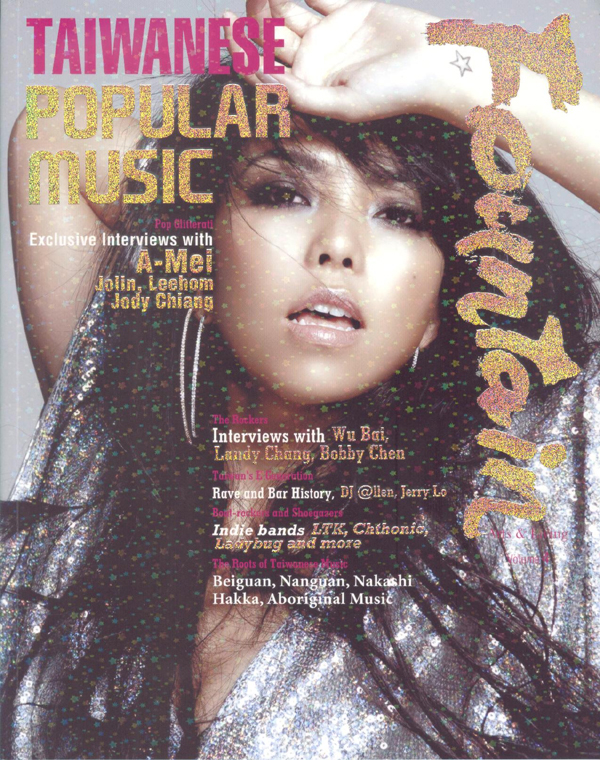
the latest English journal-issue on Taiwanese popular music

by vidieho

fountain_cover

HELLO everyone,

Long time no see.

Attached picture is the cover of latest journal Fountain issue on Taiwanese popualr music. This Journal is semi-offical , which means a ‘speaker’ for ‘Green’ governments, from former president Lee Dung-hwai to current Chen Shui-ban .

I helped as a consultant before its execution, as the chief brain is an American named David Frazier, who is free-lanced music writer for various journals and newspapers, (including Wire) who knows more about indie msuic scene but little about Taiwan’s music hisotry.

Basically he uses my PhD Dissertation as grounded reference. Although the journal does not show a criticial viewpoint, it nevertheless, would provide you good information about postwar Taiwanese popular music hisotry.

I do not know if you can get this copy in your country, please let me know if some would need a copy of it

Best

Tunghung

Ho


SPICES 2008: Commercialization, Contestation and Creative Culture: The 3rd International Conference on Inter-Asian Culture, Communication, Conflict and Peace

by homey81

CONFERENCE ANNOUNCEMENT
SPICES 2008: Commercialization, Contestation and Creative Culture

The 3rd International Conference on Inter-Asian Culture, Communication, Conflict and Peace
7-8 August 2008 (Thursday-Friday)

Universiti Sains Malaysia, Penang, Malaysia

Hosted and Organized by

Centre for Policy Research and International Studies (CenPRIS), Universiti Sains Malaysia
Co-organisers:

Faculty of Communication Arts, Chulalongkorn University, Thailand

Department of English and Communication, City University of Hong Kong

The Institute of East Asian Studies, Sungkonghoe University, Korea

Human Rights Studies and Social Development, Mahidol University, Thailand

INTRODUCTION

This ongoing series of international conferences was first convened in Bangkok in 2006. It was agreed in Bangkok that the organizers would host this conference annually at different venues, and in the following year, 2007, the conference was held at the City University of Hong Kong. In Hong Kong, we also agreed to henceforth name our collective SPICES – to reflect the diversity and richness of Asian cultures. Hence, SPICES 2008. This third conference, with the theme Commercialization, Contestation and Creative Culture,will be held at Universiti Sains Malaysia, Penang in August 2008.
CONFERENCE OBJECTIVES

  1. To bring together scholars and civil society workers from across Asia to debate and dialogue on the state of research and study in the area of culture, communication, conflict and peace.
  2. To discuss papers with new ideas and agenda that would move forward the trajectories of Inter-Asia culture and communication with open borders
  3. To network between research institutions and universities, and individual scholars, researchers and civil society workers of diverse experience and interdisciplinary background
  4. To create focal points for future exchange of knowledge and people who share common interests

SPICES 2008 CONFERENCE THEME

Commercialization and globalization have undoubtedly impacted on the development of cultural forms and strategies in the region. All too often the impact has been deemed ‘negative’, principally by local politicians and self-appointed cultural guardians, guided by their own political agendas. Such assertions, many times nostalgically yearning for a mythical past, assume the domination of certain cultural forms and practices and the subordination of ‘national’ cultures. Yet, despite some evidence to suggest the possible ‘levelling-down’ of cultures, at the same time, we see everywhere around us in the region the emergence and even development of alternative cultural forms and strategies. The young have been particularly adept at incorporating globalized cultural products and coming up with hybridized forms that speak of and from their own daily cultural experiences.

These developments pose contemporary challenges, both theoretically and politically.

Theoretically, these developments force us to reconsider possibly simplistic notions such as cultural domination and subordination, cultural authenticity and cultural autonomy. They also require us to analyze current cultural and communications practices and strategies and possibly come up with alternative forms of explanation which look at the linkages between the global, the national and the local.

Politically, the emergence and development of these new cultural strategies, not guided by official exhortations and often creatively challenging them, raise questions about the liberating potential of creative culture, often developed by members of civil society. Official discourses about ‘authentic’ cultures and the links with, for example, ethnicity and religion, are challenged.

Apart from addressing these developments, Spices 2008 aims to explore the sustainability of such indigenous developments and the capacities required for their expansion.

PANELS AND TOPICS

    1. Contestations and Indigenous Cultures
    2. Youth Cultures: Communicating Across Borders
    3. Popular Music: Commercialization, Cooptation and Consumption
    4. Gender and Popular Culture
    5. Big Media and Small Media: Commercialization and Independent Media
    6. Creative Culture: The Global, the National and the Local
    7. Transnational Film Culture and National Cinema
    8. Television, Genres and Authenticity
    9. Cultural Rights and the New Media

Groups or individuals who wish to propose other panels or present material related to the general theme of the conference, but not included in the above panels, are also invited to submit abstracts or panel proposal.
CALL FOR PAPERS

The organizers of SPICES 2008 would like to invite paper presenters to send in a soft copy of their abstracts (not more than 250 words) before 29 February, 2008 to SPICES2008@gmail.com

For further information please contact Soraya or Mahyuddin at:

Tel: +604 6532778 or +604 6533455

Fax: +604 659 1624

Email: SPICES2008@gmail.com

or

The Secretariat

SPICES 2008

Centre for Policy Research and International Studies (CenPRIS)

Universiti Sains Malaysia

11800, Penang

MALAYSIA
Taiwan Band Festival (a creative agenda?)

by terebikun

On Sunday, Nov. 25, I went to the first Taiwan Band Festival held in Huashan Cultural Park. It was drizzling lightly but overall it was possible to enjoy the event without umbrellas, which was what most people did. I ran into Tunghung and several old friends. He could probably provide more context to the logic of the festival, which certainly seems to resonate with the “creative agenda” discussed in the previous posts and comments. Basically, the Government of Information Office has this fund to support independent bands in order to prove that Taiwan could produce more than idols and the “Star Light Gang” (basically a televised singing show which has generated gangs of idols. My students can’t stop talking about them). At lease this is the logic in the promotion.

The result? Two days of bands performance, each band given 25 minutes (or three songs). Not very long. But enough to get a taste of different band styles. http://www.taiwanbandfestival.com.tw/bandlist.htm. Attaching a photo of the wild act, “Fish and the Bedroom Riot,” composed of various musicians who performed in Tunghung’s pub, Underworld, doing visual and performance experiments. On Sunday’s case, they were in various animal costumes and having way too much fun and too soft volume–due to the police (Taipei City) writing tickets for the “noise” sponsored by central government.

Fish and the Bedroom Riot

Singaporean bureaucracy trying hard to promote creativity

by sonicscape

I noticed that Eva and HJ were discussing the concept of creativity in the East Asian context. How about this? Singaporean bureaucracy is trying very hard to promote the creative city state.

Recently I am thinking over the notion of creativity and its policies in Korea too. Still very confused, but I am thinking what might have been positive effects when this notion was introduced in public policy. I am sure that some scholars including Austrailian groups think that creative industries policy is a means of progressive intellectual intervention. I am not sure about that and thinking about the conditions under which it can be considered in that way.

Nonetheless, in practice things might be very uninteresting. I am almost inclined to think that creative industries policy in Korea ends up being a small happening without much substantial effect when significant policy measures are rolled back as a result of the governmental change.

Conferencing at Minshung (Taiwan) and Drinking at Taipei (Underground Society)

by homey81

Last week I had been in Taiwan for particpating a conference about “digital culture.”  The conference venue was at National Chungcheng University at Minshung, a small city in Southern Taiwan. Among members of our group, Yoshitaka was there as “keyote speaker,” Eva as moderator/interpretator and Miao-ju as one of the hosts of the conference.

On Novermber 15, one day before the conference, Kelly Hu, who is not a member of our group but took much pains to organize the conference, and Miao-ju took us to a nice bar/restaurant and I felt very nostalgic when I saw old-style vinyl records there.

Also was there old-style television set, which seemed to be manufactured in the 1970s. They reminded me of “postwar history.”

On 17 November (the second day of the conference), Yoshitaka gave a keynote speech and Eva interpreted his talks. His talk was about the evolution of “J-pop” associating it with the development of moblie/digital technology and subcultural configurations in Japan. I would be happier if Yoshitaka can tell something about his talk~

After 2 days’ conferencing, I moved to Taipei (on 18 November) and met Tunghung for drinking in a pub/livehouse of which he is one of the owners. The name of the pub/livehouse is “underground society.” You can see how it looks like in the pictures below.

Tunghung showed us a “certificate” which permits live performance in the pub. I thought it was the outcome of his long time struggle. Tunghung, right? Nearly everywhere in Asia, we have faced with this kind of problem: fighting against bureacracy who tries to control public space for music performance.

Samll livehouses in Asian cities shares something similar. Crummy, small, dirty, untidy with posters here and there. Though it was the third time that I visited here, I always feel quite comfortable and nostalgic… As there was no live performance in Sunday night, Tunghung, who is always energetic, didn’t mind taking a role of DJ and played music which let me (us) know the history of Taiwanese popular music.

Before going out of Underground, I coudn’t resist the feeling of taking a photo with Tunghung (center) and Yoshitaka (right), who are one of the most famous music critic/scholar in Taiwan and Japan, respectively.

If anybody visit Taipei, I think he will welcome you. Tunghung, right? 🙂

HJ

Two books about popular music written in Japanese

by homey81

Two books about popular music written in Japanese.
One is Popular Music and Capitalism by Mouri Yoshitaka and the other is Youth wearing music: The pleasure of putting on and taking off by Koizumi Kyoko. Below are the English translation of the contents of the book.

Popular Music and Capitalism

ポピュラー音楽と資本主義

Intro
I. Popular Music and Capitalism
1. The introduction of Marxist Critical Theory
2. The critique of popular music by Adorno
3. The age of rebellion, the age of rock music
4. The critique from popular music studies toward Adornean pessimism

II. The End of the Age of Rock and the Industrialization of Popular Music
1. Popular music under industrialization
2. Japanese popular music in the 1970s
3. Transformation of music industry
4. Fordist mode of production and the year 1968 as its end
5. Post-fordist production system

III. The Tactics of Pop
1. Art into pop
2. Andy Warhol and Velvet Underground
3. The emergence of punk and techno and the end of the end of rock
4. KLF and the consumption of capitalism
5. The tactics of pop in Japanese popular music

IV. Race, Music and Capitalism
1. Race and popular music
2. The category called “the black”
3. Traveling (moving) music, transformed (transcultured) music
4. Black music under double exploitation
5. Against the double exploitation
6. Capitalism and race

V. Political Economy around J-pop
1. Is music really under crisis?
2. The growth of music industry in “bubble economy”
3. The increase of millionsellers and “family-restaurant-ization” of music
4. “Shibuyakei Sound” in the period of the formation (emergence) of J-pop
5. Neo-liberalist and “freeter” period in the 1990s
6. The other side of J-pop and after

VI. Musica Practica
1. Musical Pratica
2. DJ culture and DiY culture
3. Musical Practices in digital age
4. Musical Practices in Fukuoka : music, city, tenshin
5. What is popular music? (reprise)

Youth wearing music: The pleasure of putting on and taking off

音楽をまとう若者

Introduction

Chapter 1 Genealogy of task of Popular Music Studies
1. Crossing the bridge between the inside and outside of school
2. Education and popular music
3. Subcultural studies and popular music
4. Popular music as cultural capital
5. Popular music and gender

Chapter 2 Formal Space
1. Triparted space, intersecting each other
2. Highschool boys in classsroom
3. Highschool girls in classroom
4. Triparted level system of popular music
5. ‘Tactics’ and ‘operation’
6. Brass Band circle

Chapter 3 Semi-formal Space
1. Male members in folksong circle
2. Female members in folksong circle
3. Highschool band events

Chapter 4 Informal Space
1. Male highschool boys who are occupied with “listening”
2. Visual J-rock bands and “cosplay” highschool girls
3. Boys’ band
4. Girls’ band

Chapter 5 Youth wearing on music

school drama project theme song_English & Cantonse versions

by angel_lin

hi all, just want to share with u below a song written by high school students in HK; it’s the theme song of a Net-drama project of the HKRSS secondary school, a working class school located in the rural area in HK.  The music, the lyrics, the vocals, the MV were all done by students… (except for the English lyrics, which was written by a teacher)…  it’s in the Cantopop genre, but showing much of the talent of the young students in HK…

Riding a Melodic Tide: Development of Cantopop in HK

by angel_lin  hi all! i just came back from the Hong Kong Heritage Museum, where Anthony organized the Opening Ceremony for a series of activities (exhibtions, talks, seminars) on the history and development of Cantopop in Hong Kong.  I attach some pics here: Anthony with Allan Tam: a HK Cantopop icon :). And then we chatted with Poon Wai-Yuen, a lyricist who wrote the lyrics of many good songs for Anita Mui in the 90s (the Catopop diva who passed away a few years ago)…  i had written a paper on his lyrics (and presented in Hyunjun’s conference in Yonsei 2 years ago), but didn’t have chance to meet the lyricist until today… 🙂 the touching moment is when Sam Hui’s son, Ryan Hui, sang Sam Hui’s early Cantopop song with Sam Hui’s guitar… that’s a touching moment for those who grew up with Cantopop…  Sam Hui almost started Cantopop as an indigenous music form for HK… http://www.heritagemuseum.gov.hk/english/exhibition.htm mcyan-x-ypfringe_

anthony_allan-tam-development-of-cantopop-in-hk_opening-ceremony_ anthony_angel_lyricist-poon-wai-yuen-hk-heritage-museum_

obituary: lance hahn

by plateaux

it’s not exactly a breaking news, but still a heartbreaking loss. lance hahn was an accomplished asian american indie rock musician (of chinese descent) who participated in the first asian american compilation ‘ear of the dragon'(1995). the webzine pitchfork ran an obituary here. and the following is a short obituary written by an iaspm-us member:

Dear IASPMites,

I’m not sure how many of you would be interested in the news, but just in case, I thought I’d pass it on: Lance Hahn, singer/guitarist/songwriter for pop-punk band J Church and longtime writer for _Maximum Rock ‘n Roll_ and _Giant Robot_
passed away from complications due to kidney disease this Sunday past, October 21st. He was 40.

AK Press will publish posthumously his history of ’80 British anarcho-punk, which orginally appeared in installments in MRR.

His friends here in Austin, TX, are planning a memorial service and have put up a website where friends and fans can leave farewells:

http://welovelancehahn.com

Best,

David Uskovich
PhD Candidate
Dept. of Radio-TV-Film
University of Texas at Austin